
|
Class War’s Poor Doors Victory – An Insider’s View
Jon Bigger
24 July 2019
In July 2014 a number of people from Class War had gathered in South Norwood for the opening of the Sensible Garden, a strip of unused land reclaimed by the South Norwood Tourist Board for the community. One of them was angry, which I guess isn’t too unusual for Class War. On this particular occasion it was a newspaper report highlighting social segregation at a block of flats at One Commercial Street in Aldgate on the edge of the City of London that had provoked.
They burst into the
gathering saying that something had to be done. They insisted. At that moment
the best political campaign I’ve ever been involved in started and the ripples
from that day continue to spread out. Last week the government announced that
they would end what became known as Poor Doors and the segregation they create.
I committed to being a Class
War election candidate in autumn 2013 and the Poor Doors campaign overlapped
our preparations for the 2015 general election. In fact I don’t think you can
write about the Class War election campaign without telling the story of their
Poor Doors campaign too. I’m currently writing a thesis on what Class War did
in the election, how and why they stood candidates and Poor Doors helps set the
scene.
I’m not going to write about
the election here too much but it is important to point out what the Poor Doors
campaign gave us. It provided a focal point to rally behind. Very quickly the
protests we held turned into weekly gatherings. The dates and times were well
publicised and the protests just seemed to grow and grow. It was in the pub
before and after Poor Doors protests that Class War (at least the London part
of it) were able to do their election planning on top of arranging the protests
themselves. As a method of organising it was somewhat unorganised but it was
amazing how much was achieved as people just openly discussed the plans for the
protests, huddles around pints in small groups: traditional Class War democracy
in action.
We had been looking for a
reason to have weekly meetings for a while for the purpose of the election and
then suddenly this issue made it possible. Not that any of the discussions were
officially minuted or an agenda produced. It was much more organic than that.
It was simply a regular time and place where people got organised.
The protests themselves were
sometimes just festival like. Musicians came along as we talked to passers-by.
Other protests were a bit more aggressive in style. At the second protest I
recall a resident in the rich area of the flats dropping urine on the protest
below, much to the annoyance of the police when that whipped up anger.
Sometimes people from the poor area of the flats would join us to tell us about
what segregation feels like.
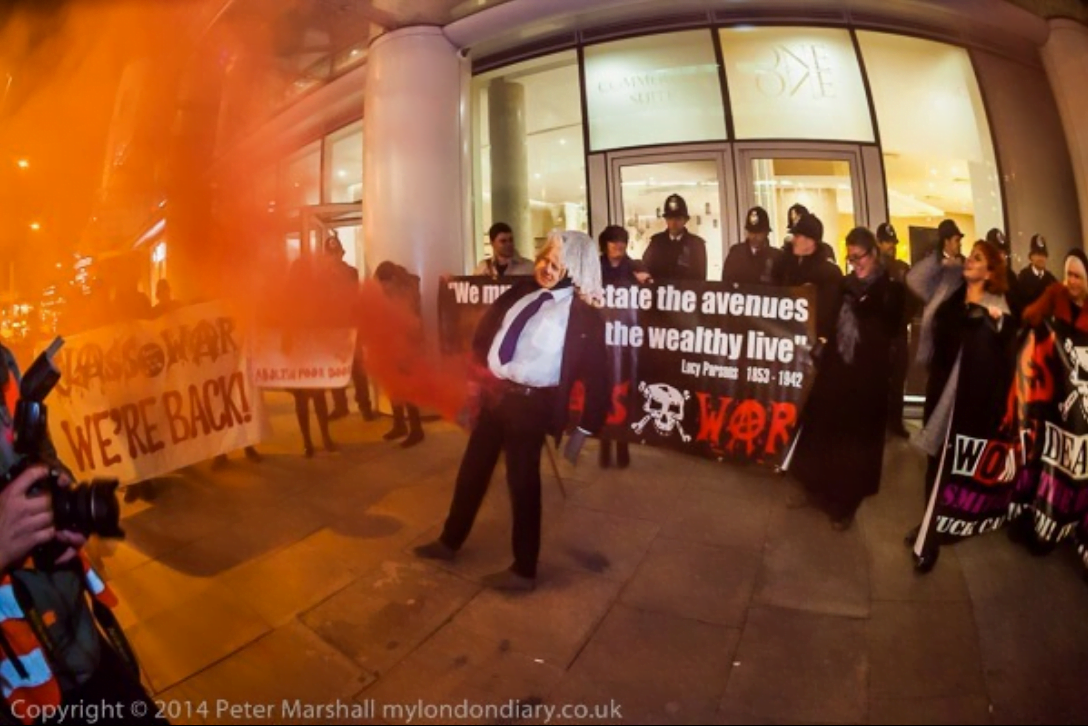
As the protests grew, so did the police presence. This led to arrests on four occasions to my counting. On one occasion we managed to get into the foyer of the rich flats and in the altercations that followed a vase of flowers was knocked off a desk resulting in arrest for Ian Bone, and the some imaginative adverts for the next protest on behalf of the anarchist group Vase War. One person was arrested for refusing to let go of what the police claimed was an offensive banner declaring politicians David Cameron, Ed Miliband, Nick Clegg and Nigel Farage “All Fucking Wankers”. At the protest on November 5th 2014 Jane Nicholl was arrested for setting fire to an effigy of Boris Johnson who was London mayor at the time. Finally in the run up to the election Lisa Mckenzie, who had got involved with Class War for a time after coming to an early Poor Doors protests and then becoming a Class War candidate in the election, was arrested for allegedly putting a sticker on a window at the development.
Class War wouldn’t have had Lisa
and at least one other candidate if it hadn’t been for Poor Doors. It seemed to
inspire people to sign up to helping the election campaign in whatever way they
could and we saw our online presence grow as a result. This enabled us to
organise two massive protests early on coinciding with the London Anarchist
Bookfair and student protests in October and November respectively. The protest
on the day of the national student march included some battles with the police
as the crowd swelled into the road and attempted to gain entry to the building.
In November 2014 the owners
of the building gave up and sold it on. The new owners were willing to
negotiate so Class War went into discussions with them. I’m told the meeting
didn’t go well and so a truce was short lived. Protests restarted and the break
didn’t prevent momentum. The protests just got bigger and more interesting. The
introduction one evening of flaming torches and a spontaneous march blocking
Tower Bridge produced some fantastic photo opportunities but also took the
message beyond the local area.
Likewise, the publicity that
Class War received meant that the protests were known about beyond our own
little world. Union banners were brought along and other groups came to provide
solidarity. The E15 Mothers were visitors on occasion for example and there was
a sense that housing campaigns were coming together, links were being made and
a general fightback being organised.
Of course, fighting poor
doors at one residence could only ever really be symbolic of a wider problem
and by the New Year we were starting to wonder how long we could carry on. A
second front was created for us with the news that a new development at Tower
Bridge would also have poor doors and segregated garden space. This created
problems for a small group. I don’t want to give the impression that hundreds
of people turned up to every Poor Doors protest. Sometimes it was just a few of
us. Sometimes it was rowdy and sometimes it was just jolly. The importance was
that it was a regular nuisance to the powerful and a regular chance for us all
to get together.
The Class War Womens Death
Brigade (WDB) was formed during the protests. There are frankly better people to
talk about this group than me, except to say that it emphasised the Class War
in its current iteration perfectly. When Jane Nicholl was arrested and subsequently
banned from protesting at the building until her trial, the following protest
saw the WDB turn up wearing identical outfits to the one worn by Jane when she
was arrested. Solidarity was the order of the day while Jane waited in a pub
just outside the exclusion zone for a post protest drink or two. Meeting weekly
allowed this to be just as much a social event as a political protest. And this
consequently made it difficult to police. The sight of a several women dressed identically
dancing behind a banner a declaring “FUCK CAPITLAISM, FUCK PATRIARCHY” seemed
to flummox the police a little. They really didn’t know how to deal with them.
One week before the election
the first Fuck Parade was organised. The idea was to have a party through the streets,
starting at One Commercial Street and then just moving off wherever the crowd
chose to go. It was May Day and the turnout was fantastic. Protests were always
good when the Met Police were busy. It often meant the City of London Police
were called in to deal with us instead. They didn’t seem to have a clue and
were prone to making the odd mistakes which whipped up the crowd. The Met, let’s
face it, know how to handle large crowds. That frisson of excitement you get
when you see the Met have left it to the numpties this week because they’re
stretched doing other stuff.
On the day of the general
election some of us were in court with Jane Nicholl watching the police try to
argue that effigies shouldn’t be burned on Guy Fawkes Night. Actually they kept
changing the charge in an effort to get her locked up. They eventually settled
on endangering life and relied on one of their number being the person
terrified for their existence. The only problem they had was the evidence of
collusion in their notes and the fact that the only picture of the terrified
officer was of him standing close to the effigy as it burned, with his hands
behind his back, smiling. Their case collapsed. The Met may be good at crowd
control, not so hot in court as was proved with the other cases. Lisa McKenzie
was found not guilty later and much later the protester who had been arrested
for refusing to let go of the ‘offensive’ banner had their case collapse before
it reached court as it turned out the police had destroyed the banner: the only
evidence they had.
Now we have the news that
the Tories plan to outlaw Poor Doors. An opportunity missed by Mayor of London,
Sadiq Khan, who pledged to do this when he came into office. A victory for
Class War? Well, we’ll say so. The Poor Doors protests are significant for a
number of reasons. The first is that they helped Class War organise for the
election campaign. The second is that they renewed Class War, giving it a
regular weekly outing which brought in new people and new ideas in the fight
against gentrification. The third is that it kept the issue of poor doors in
the news. The media rarely mention the Class War campaign itself but would the
issue be prominent if those weekly protests hadn’t captured the imaginations of
people? The protests were reported on around the world and Class War ensured
that.
Organising weekly protests
is something I’ve done with a few different groups now. With each one they have
turned out to be amazing and successful. I think we can learn a great deal from
the Class War Poor Doors protests. Even meeting just socially before and after
the protest was enough to get things ready and prepared each week. Imagine what
could be achieved with agendas and minutes, if you must.
Victory to Class War then but more importantly the end of poor doors seems in sight. Those of us involved will rejoice at that but we will also always miss those vibrant, fun, protests. They were a wonderful way to do politics.
Jon Bigger
Photo credit: Peter Marshall
Class war

Freedom
Bookshop
Class war

This week in Class War Daily
It’s been another busy week for Class War Daily: the world’s only daily anarchist newspaper (we think; please feel free…
Jon Bigger
New In




Freedom Press

Subscribe to Freedom anarchist journal, sustain radical publishing and support independent media.
SUBSCRIBE
AND DONATE
Latest
Andy Burnham’s antidote fallacy
For all his talk of devolution, the PM’s reforms are likely to embed the state ever more intrusively in our lives
Jon Bigger
|
16 September 2026
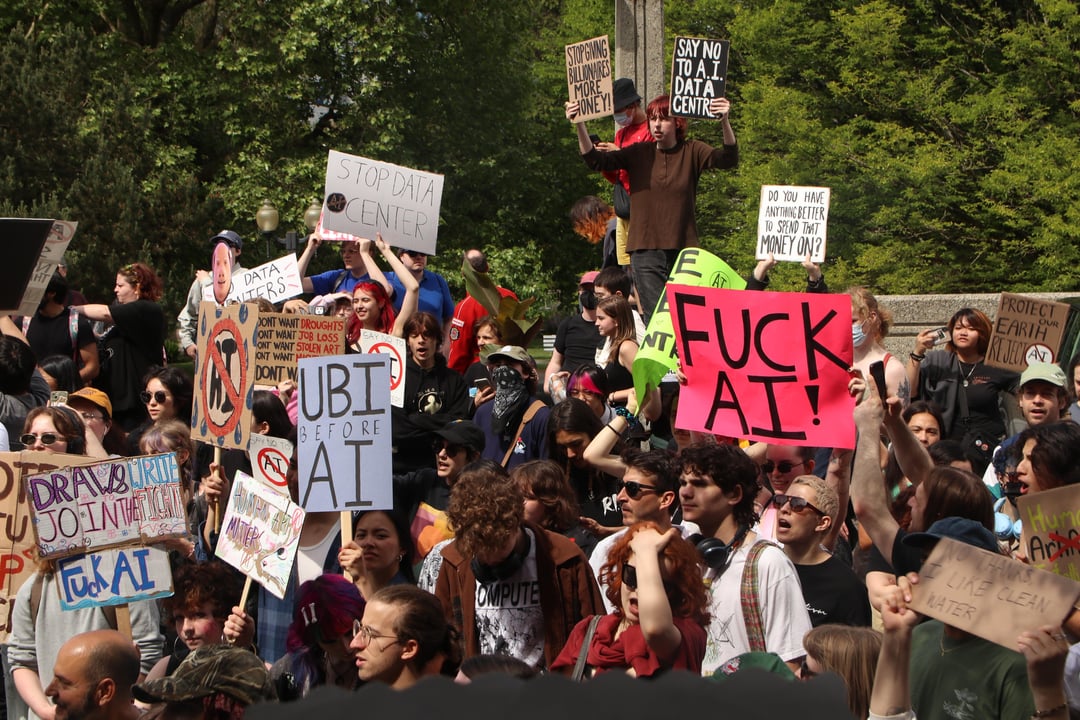
Climate activists confront data centres
The surge of AI‑powered data centres is straining the electric grid, draining water supplies, and forcing a new wave of climate‑justice activism
Joel Sucher
Browse over a century of anarchist commentary and reporting from the Freedom digital archive
EXPLORE THE
Archives