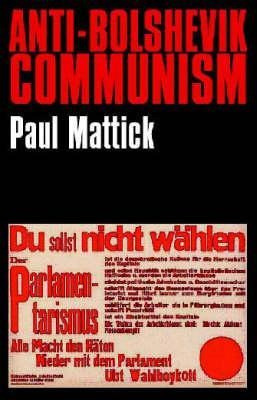





Anti-Bolshevik Communism

£14.95

|

1 in stock

1 in stock

Communism aims at putting working people in charge of their lives. A multiplicity of Councils, rather than a big state bureaucracy is needed to empower working people and to focus control over society. Mattick develops a theory of a council communism through his survey of the history of the left in Germany and Russia. He challenges Bolshevik politics: especially their perspectives on questions of Party and Class, and the role of Trade Unions. Mattick argues that a The revolutions which succeeded, first of all, in Russia and China, were not proletarian revolutions in the Marxist sense, leading to the a association of free and equal producersa, but state-capitalist revolutions, which were objectively unable to issue into socialism. Marxism served here as a mere ideology to justify the rise of modified capitalist systems, which were no longer determined by market competition but controlled by way of the authoritarian state. Based on the peasantry, but designed with accelerated industrialisation to create an industrial proletariat, they were ready to abolish the traditional bourgeoisie but not capital as a social relationship.This type of capitalism had not been foreseen by Marx and the early Marxists, even though they advocated the capture of state-power to overthrow the bourgeoisie a but only in order to abolish the state itself.

Anti-Bolshevik Communism

£14.95

|

1 in stock

1 in stock

Communism aims at putting working people in charge of their lives. A multiplicity of Councils, rather than a big state bureaucracy is needed to empower working people and to focus control over society. Mattick develops a theory of a council communism through his survey of the history of the left in Germany and Russia. He challenges Bolshevik politics: especially their perspectives on questions of Party and Class, and the role of Trade Unions. Mattick argues that a The revolutions which succeeded, first of all, in Russia and China, were not proletarian revolutions in the Marxist sense, leading to the a association of free and equal producersa, but state-capitalist revolutions, which were objectively unable to issue into socialism. Marxism served here as a mere ideology to justify the rise of modified capitalist systems, which were no longer determined by market competition but controlled by way of the authoritarian state. Based on the peasantry, but designed with accelerated industrialisation to create an industrial proletariat, they were ready to abolish the traditional bourgeoisie but not capital as a social relationship.This type of capitalism had not been foreseen by Marx and the early Marxists, even though they advocated the capture of state-power to overthrow the bourgeoisie a but only in order to abolish the state itself.

Recommended

Freedom

Bookshop

Angel Alley
84b Whitechapel High St
London E1 7QX

Opening hours: 12pm to 6pm

New in

Latest

Subscribe to Freedom anarchist journal, sustain radical publishing and support independent media.

SUBSCRIBE

AND DONATE

Economics

Philosophy and Theory

something in

particular?

Not everything available in the physical bookshop is currently listed online. If you are searching for a particular book, periodical, or other product please get in touch and we may be able to source it for you