
|
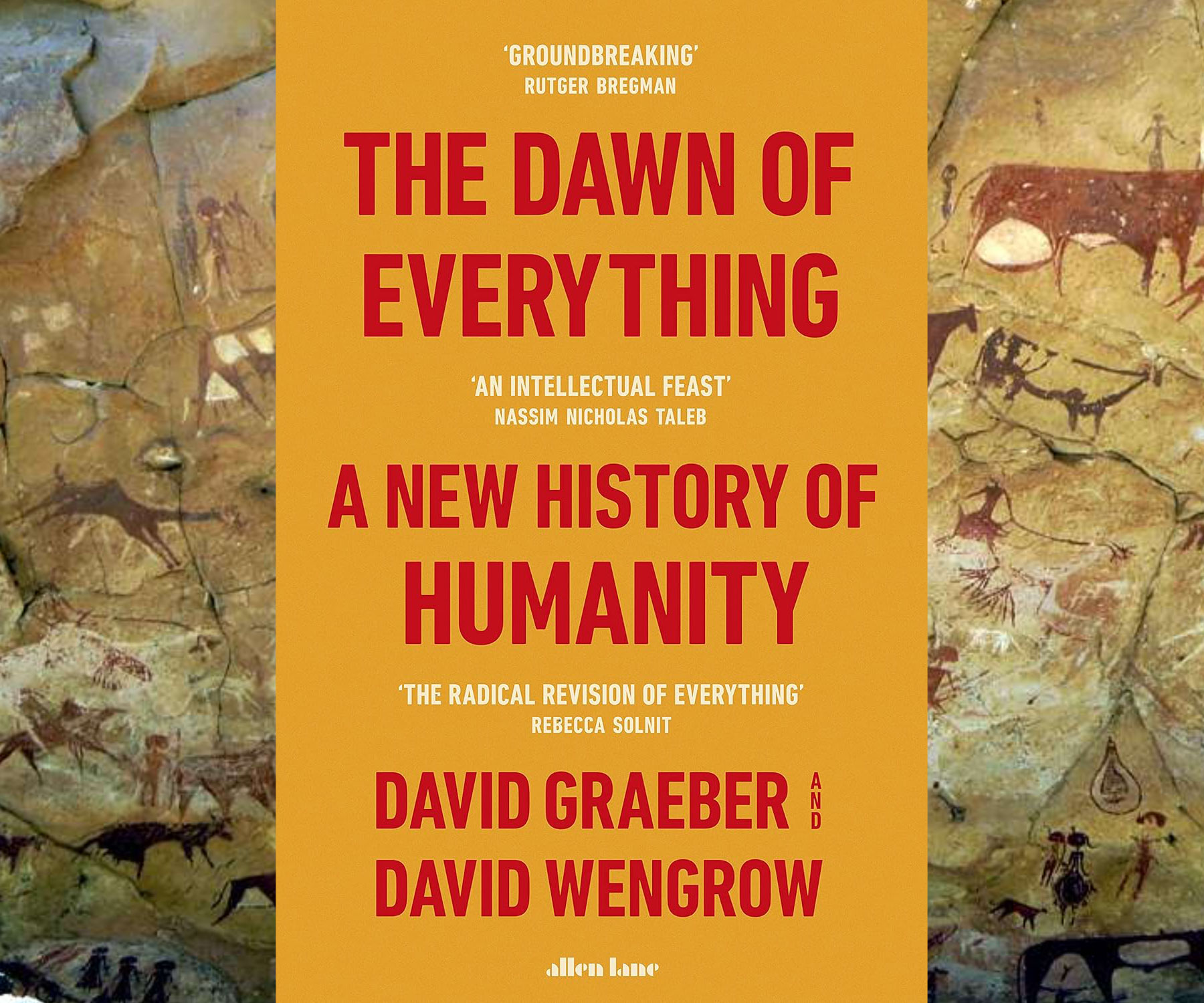
Review: The Dawn of Everything
After reading a few Marxist criticisms of Graeber and Wengrow’s book, I decided to take a look because if something displeases a Marxist, it will surely make me laugh.
Acratosaur
16 September 2023
After reading a few Marxist criticisms of Graeber and Wengrow’s book, I decided to take a look because if something displeases a Marxist, it will surely make me laugh. After a cursory glance, I understood the rejection.
ISBN: 978-0-141991-06-1
by David Graeber and David Wengrow
Published: June 2022
720 pp
£12.99
The Dawn of Everything is a book of anthropology and archaeology which suggests a vision of the prehistory of humanity that is very different from previous evolutionary texts. It is very well documented, very well written and enjoyable. That it is well written, entertaining and easily understandable is something academics, who in general terms always try to be as opaque as possible, do not usually like. If something is so incomprehensible that the posh don’t understand it then students can spend years and years trying to unravel the teacher’s hieroglyphics, which is ideal. This generally happens at universities, no matter the trend – and if said knowledge is also inapplicable to anything useful, it is perfect. But there is one inexcusable sin for any Marxist, apart from being insufficiently cryptic, obscure and indigestible. If the writer does not quote Marx, Engels, Lenin, Gramsci or any obtuse theorist about six times per page, they do not consider one to be quality work. And that is what bothers about The Dawn of Everything for the old people who dried their meninges reading Das Kapital: that in 700 pages, Marx is mentioned five times, in passing, along with other authors like Confucius. And they name Marxists, among many others, as if that current of intellectuals had the merely same importance as Bentham’s utilitarianism. Intolerable. The Dawn of Everything suggests a different interpretation of the origin of civilization following archaeological discoveries from the last 30 years. The authors raise problems and avoid categorical statements. This can be useful because it facilitates the reader’s reflection so that they can reach their own conjectures. From the beginning, they warn that there is a lot left to unearth, a vast world to glimpse and note that it is an impossibility to know with certainty what something our ancestors did 30,000 years ago means. Of course, that bothers Marxists a lot with their evolutionary scheme of “primitive communism”, “agrarian empires”, “slave societies”, “feudal world”, “bourgeois capitalism”, and “communist future”. Because the Marxists are scientists, they are not ambiguous, and they openly tell you that in the Paleolithic, there was class struggle, although we have no fucking idea what was going through those people’s heads. And for two academics to come to you now, who have read everything published in ten years, to propose that the Enlightenment did not simply emerge from the European “class struggle”, but rather that it was inspired by American Indians, is something that grates on them. In the gears of the brain. Please note that I do not despise either Marx or Marxists. For me, the ability of the acolytes of Marxism to analyse the past, present and future is similar to that of Witch Lola from my neighbourhood, whom I respect a lot. I even affirm that contemplating a Marxist at his peak is like meditating before some especially interesting creature due to its scales, horns and the size of its enormous and gigantic ego, nourished by concepts that must be made to fit, with hammer blows if necessary, in anthropoid communities. The Future, today, is unpredictable. And The Dawn of Everything, I like it. ~ Acratosaur
This review is an edited translation of an article from alasbarricadas
ISBN: 978-0-141991-06-1
by David Graeber and David Wengrow
Published: June 2022
720 pp
£12.99
The Dawn of Everything is a book of anthropology and archaeology which suggests a vision of the prehistory of humanity that is very different from previous evolutionary texts. It is very well documented, very well written and enjoyable. That it is well written, entertaining and easily understandable is something academics, who in general terms always try to be as opaque as possible, do not usually like. If something is so incomprehensible that the posh don’t understand it then students can spend years and years trying to unravel the teacher’s hieroglyphics, which is ideal. This generally happens at universities, no matter the trend – and if said knowledge is also inapplicable to anything useful, it is perfect. But there is one inexcusable sin for any Marxist, apart from being insufficiently cryptic, obscure and indigestible. If the writer does not quote Marx, Engels, Lenin, Gramsci or any obtuse theorist about six times per page, they do not consider one to be quality work. And that is what bothers about The Dawn of Everything for the old people who dried their meninges reading Das Kapital: that in 700 pages, Marx is mentioned five times, in passing, along with other authors like Confucius. And they name Marxists, among many others, as if that current of intellectuals had the merely same importance as Bentham’s utilitarianism. Intolerable. The Dawn of Everything suggests a different interpretation of the origin of civilization following archaeological discoveries from the last 30 years. The authors raise problems and avoid categorical statements. This can be useful because it facilitates the reader’s reflection so that they can reach their own conjectures. From the beginning, they warn that there is a lot left to unearth, a vast world to glimpse and note that it is an impossibility to know with certainty what something our ancestors did 30,000 years ago means. Of course, that bothers Marxists a lot with their evolutionary scheme of “primitive communism”, “agrarian empires”, “slave societies”, “feudal world”, “bourgeois capitalism”, and “communist future”. Because the Marxists are scientists, they are not ambiguous, and they openly tell you that in the Paleolithic, there was class struggle, although we have no fucking idea what was going through those people’s heads. And for two academics to come to you now, who have read everything published in ten years, to propose that the Enlightenment did not simply emerge from the European “class struggle”, but rather that it was inspired by American Indians, is something that grates on them. In the gears of the brain. Please note that I do not despise either Marx or Marxists. For me, the ability of the acolytes of Marxism to analyse the past, present and future is similar to that of Witch Lola from my neighbourhood, whom I respect a lot. I even affirm that contemplating a Marxist at his peak is like meditating before some especially interesting creature due to its scales, horns and the size of its enormous and gigantic ego, nourished by concepts that must be made to fit, with hammer blows if necessary, in anthropoid communities. The Future, today, is unpredictable. And The Dawn of Everything, I like it. ~ Acratosaur
This review is an edited translation of an article from alasbarricadas
Anthropology
















Freedom
Bookshop
Anthropology

New In
















Freedom Press
























Subscribe to Freedom anarchist journal, sustain radical publishing and support independent media.
SUBSCRIBE
AND DONATE
Latest
Churchill vandalism case win, and thoughts on masked fash
Anarchist News Review: Andy, Tab and Simon hail some good news for pigeons as a jury throws out the infamous Churchill statue vandalism case.
Freedom News
|
18 September 2026
Autistici/Inventati: “We need 1,000 more infrastructures of dissent to be born”
Interview with the Italian digital collective, de-banked and shut down after US “terrorist” designation
Gabriel Fonten
Browse over a century of anarchist commentary and reporting from the Freedom digital archive
EXPLORE THE
Archives