Were early human societies egalitarian? How can we know about this? And how far are gender perspectives addressed in these questions? And does it ultimately matter? Anthropologist Camilla Power asks the questions.
Camilla Power
|
29 January 2019
It is a longstanding position in
anthropology that hunter-gatherers, especially nomadic groups who consume all
they forage the same day – known as ‘immediate-return’ – are notably more
egalitarian than any other society we have evidence for.
The word ‘egalitarian’
itself was adopted by James Woodburn, who has 60 years (and counting!) of
fieldwork with the Hadza in Tanzania. This implies assertive, ideological
adherence to equality. People are actually different in terms of age, sex, strength,
capacities and abilities, but their egalitarian attitude insists on equal
treatment in terms of sharing, personal autonomy and decision-making.
Egalitarian societies are always working at the maintenance of this type of
equality, always on the lookout for anybody trying to aggrandize themselves,
threatening the balance of power. This, in Woodburn’s view, makes them
exceptionally stable over time.
As anarchist
Brian Morris, who has long-term fieldwork with the south Indian Pandaram,
says, these societies really are both anarchist, with emphasis on personal
autonomy and no one being in charge, but also communist in terms of sharing of
resources, and cooperation in labour.
Challenges
to the egalitarian hunter-gatherer model
There have been a number of challenges to the
emphasis on egalitarianism among recent and extant hunter-gatherers. One is to
historicise hunter-gatherer populations, looking more at their recent and contemporary
interactions with farming, herding and nowadays capitalist economies. This
argues that we cannot use current hunter-gatherers successfully as models for
human evolution. Too much has changed.
Others claim wide diversity in economy,
environment, culture and technology of hunter-gatherers on different
continents. Different groups can be contrasted as immediate vs delayed return,
with the latter possessing technologies for storage, enabling surpluses and
social stratification. Some of these
societies have historically had relations of slavery and labour exploitation.
Sometimes, these are termed ‘complex’ hunter-gatherers, with settlement and
higher population densities. But the idea that maintaining egalitarian
relations is somehow politically more ‘simple’ compared to instituting
hierarchy is a deeply questionable one.
Another approach pursued by evolutionary
ecologists is to track wealth transmission down the generations. Very little
material wealth is actually inherited in immediate-return societies, but these
authors point to inherited variation in health and strength, and variation in
social connections as significant causes of inequality, which is passed down
generations. Yet despite these meticulous searches for sources of inequality
(yes, of course, some people are stronger and more healthy than others, and
that would indeed impact on children), the ideological insistence on equality
of opportunity and access remains robust and profound in these societies. It persists
long after the people concerned have lost their traditional lifestyles under
the impacts of modernity.
Anarchists
trashing hunter-gatherer egalitarianism
A recent challenge to the ‘narrative’ of
hunter-gatherer ancestral egalitarianism comes from a surprising quarter, anarchist
anthropologist David Graeber with colleague David Wengrow. They attack the ‘myth’ that humans had once
enjoyed equality and freedom in hunter-gatherer bands, until the invention of
farming sent us down the road to social inequality.
The biggest problem with Graeber and
Wengrow’s contribution is that they try to deal with the topic of the origins
of inequality without addressing gender in any satisfactory way. The big risk
in this gender-blind analysis – whether we take it as about human origins or
about the emergence of inequality – is that attacking hunter-gatherer
egalitarianism has the effect of undermining our understanding of gender
egalitarianism as well. It leaves us with a default picture of male dominance
as part of human evolution all the way. In its most biologically reductive
version, this is ‘patriarchy theory’, the idea that men have always had more
strength, more practice with weaponry, and so always dominated women. While
they did the important things like big-game hunting and social connections,
women stayed home with the babies.
This is a travesty of the reality of gender
relations among nomadic hunter-gatherers. Women have very powerful means to
resist men’s exploitation and evade their control, through their solidarity, collectivity
and social networks. Among immediate-return hunter-gatherers, men cannot coerce
women or children.
Graeber and Wengrow neglect the careful
studies that show African hunter-gatherer women lose status and
freedom from male control as they become more sedentary. This
happens when women are less able to move and avail themselves of sophisticated support
networks. African hunter-gatherers especially resist the atomization of
nuclear families using many mechanisms to create links between far-flung
friends and relatives. One diagnostic of truly egalitarian hunter-gatherers
is that people can live
where they choose.
When discussing Ian Morris’s economic
income models of Palaeolithic life, Graeber and Wengrow themselves add in, ‘but
what about all the free stuff: security, dispute resolution, primary education,
care of the elderly, medicine, music, religion…’. Their list goes on, and yet,
significantly, they leave out free collective
childcare – probably the single most telling aspect of gender relations
among hunter-gatherers, according to modern-day anthropology.
Human
origins: gender relations are central to the story
Graeber and Wengrow are definitely not
speaking about human origins because a) they give no context of evolution; b)
they don’t deal with sex and gender; c) they leave out Africa, the continent on
which we evolved as modern humans. If we put gender relations central to the
story of human evolution, a very different picture from the patriarchy model
emerges. Gender egalitarianism appears pivotal to the evolution of our
language-speaking ancestors
What evidence is there for an increasing
egalitarian tendency in human evolution, and why did this necessarily have a
dimension of gender? There are three main areas to consider: firstly, our
species biology, life history and evolved psychology – the evidence of our
bodies and minds; secondly, the ethnography of foraging peoples, particularly
African hunter-gatherers, who give us specific insight into how egalitarianism
works in practice; and thirdly, the archaeological record in Africa of art and
symbolism stretching back long before 40,000 years.
What are the egalitarian features of our
anatomy, life history and psychology?
1. Our eyes – We are the only one of
well over 200 primate species to have evolved eyes with an elongated shape and
a bright white sclera background to a dark iris. Known as ‘cooperative
eyes’, they invite anyone we interact with to see easily what we are
looking at. By contrast, great apes have round, dark eyes, making it very
difficult to judge their eye direction.
2. Intersubjectivity – Our eyes are
adapted for mutual mindreading, also called intersubjectivity; our closest
relatives block this off. To look into each other’s eyes, asking ‘can you see
what I see?’ and ‘are you thinking what I am thinking?’ is completely natural
to us, from an early age.
3. Mothers
and others – the most convincing account of how, when and why
intersubjectivity and cooperative eyes evolved is given by Sarah Hrdy in her
great book Mothers and others. We do
babysitting in all human societies, mothers being happy to hand over their
offspring for others to look after temporarily. African hunter-gatherers are
the champions of this collective form of childcare, indicating that it was
routine in our heritage. In stark contrast, great ape mothers – chimpanzees,
bonobos, gorillas and orang utans – do not let their babies go. They don’t dare
take the risk.
4. Grandmothers, menopause and childhood
– This particularly applies to apes.
Monkeys behave differently, being prepared to leave a baby with a trusted
relative. The key factor involved is exactly how closely related individuals
are. Old World monkey mothers usually live with female relatives; great ape
mothers don’t. This means ape mothers have no one nearby whom they can trust
sufficiently. This is telling us something significant about the social
conditions in which we evolved. Our foremothers must have been living close to
trusted female relatives, the most reliable in the first place being a young
mother’s own mother. This ‘grandmother
hypothesis’ has been used to explain our long postreproductive lifespans –
the evolution of menopause.
Coevolving with
grandmothers were children. Childhood is defined as the period after an infant
is weaned from the breast before the child has any permanent teeth. During that
time, children need help with finding a diet they can process, and that is
where grandma steps in. In this way, in evolution mother’s mother would have
had a big impact on a child’s survival, while the mother could begin the cycle
of having her next baby. This has resulted in the special characteristic of
‘stacked’ families among humans, where a mum has several dependent offspring at
once. With no one to help, other great
ape mothers have to have very long intervals between births, breastfeeding
until each offspring can become an independent juvenile. Little apes have no
childhood in the sense of a supportive transition period, and this is the time
when many of them will die.
Hrdy shows how
multi-parental care shaped the evolution of our species’ unique psychological
nature. While cooperative childcare may start with the mother-daughter relationship,
bonding with grandchildren quickly leads to the involvement of aunts, sisters,
older daughters and other trusted relatives. From the moment when mothers allow
others to hold their babies, says Hrdy, selection pressures for new kinds of
mind-reading are established. These give rise to novel responses – mutual
gazing, babbling, kissfeeding and so forth – which enable this variegated triad
of mum, baby and new helper to consolidate bonds while monitoring one another’s
intentions.
5. Our
huge brain volumes – While a human and chimp mother have a fairly
similar body weight, adult humans today have upwards of three times the brain
volume of a chimp. Brain tissue is very expensive in terms of energy requirements.
Doing the whole job by themselves, great ape mothers are constrained in the
amount of energy they can provide to offspring and so apes cannot expand brains
above what is known as a ‘gray ceiling’ (600 cc). Our ancestors smashed through this
ceiling some 1.5-2 million years ago with the emergence of Homo erectus, who had brains more than twice the volume of chimps
today. This tells us that cooperative childcare was already part of Homo erectus society, with concomitant
features of evolving cooperative eyes and emergent intersubjectivity.
We can track the
degree of egalitarianism in the societies of descendants of Homo erectus, by measuring brain sizes
in these early humans, using the fossil record. From 6-700,000 years ago we
begin to see cranial values in the modern human range, three times as large as
present day chimps. From half a million years ago, for both African (modern
human ancestor) and Eurasian (Neanderthal ancestor) populations, brain size
accelerates rapidly. What we find evidenced in the fossil record is materially
more energy for females and their offspring. This implies an inevitable
gendering of the strategies that enabled this to happen.
Male dominance and
strategic control of females would have obstructed these unprecedented
increases of brain size. Those populations where male dominance, sexual
conflict and infanticide risks remained high were not the ones who became our
ancestors. Our forebears were the ones who somehow solved the problem of great
ape male dominance, instead harnessing males into routine support of these
extraordinarily large-brained offspring.
Why such big brains? Machiavellian intelligence
leads to egalitarian relations
Large increases of
brain size are vanishingly rare in evolution because of the expense. What are
these large brains for? One major hypothesis is the Social Brain theory. This
relates brain size, specifically the size of the neocortex, across primate
species, to the degree of social complexity, the network of relationships that
any individual needs to deal with. This
can be measured by average group sizes for any particular species, or sizes of
coalitions and cliques within social groups. One version of the ‘social brain’ focuses on
specifically female group sizes as most critical in driving the evolution of
intelligence.
Originally, ‘social
brain’ was called Machiavellian intelligence. This is a subtle idea that sees
animals in complex social groups competing in evolutionary terms by becoming
more adept at cooperation, and more capable of negotiating alliances. In this
theoretical perspective, then, the significant increases of brain size in the
primate order, from monkeys to apes, and then from apes to hominins, result
from increasing political complexity and ability to create alliances.
Egalitarianism is
difficult to explain using Darwinian theory premised on competition. Andrew
Whiten, one of the inventors of Machiavellian intelligence theory, and his
student David Erdal saw that Machiavellian intelligence could generate the
difference between primate-style dominance hierarchies and typical
hunter-gatherer egalitarianism. At a
certain point, the ability to operate within alliances exceeds the ability of
any single individual, no matter how strong, to dominate others. If the
dominant tries, he (assuming ‘he’ for the moment) will meet an alliance in
resistance who together can deal with him. Once that point is reached, the
sensible strategy becomes not to try to dominate others, but to use alliances
to resist being dominated oneself. This was termed ‘counterdominance’ by Erdal and Whiten, and they used it to
describe what is found regularly in African hunter-gatherer societies,
so-called demand-sharing, an attitude of ‘don’t mess with me’, humour as a
levelling device, and the impossibility of coercion since no particular individual
is in charge. They saw counterdominance as fundamental to the evolution of
human psychology, with competing tendencies for individuals to try to get away
with bigger shares where opportunity presents, but, faced with demands from
others, to give in and settle for equal shares. Whiten and Erdal focused on
food-sharing as the most visible aspect of hunter-gatherer egalitarianism. But
how does sex fit into this model? Whiten and Erdal noted the hunter-gatherer
tendency for monogamy, or serial monogamy, which contrasts with polygyny among
propertied farmers and herders. But again we need to go to our biology to see
the underlying features of our reproductive physiology that lead to
reproductive egalitarianism – the most significant form of egalitarianism from
an evolutionary perspective.
This gives us the next
egalitarian feature of our anatomy:
6. Women’s
sexual physiology – This can be described as levelling and
time-wasting. Why? Because if a hominin female really needs extra energy for
her hungry offspring, better to give reproductive rewards to males who will
hang around and do something useful for those offspring. Our reproductive signals make life
hard for males who want to identify fertile females, monopolise the fertile moment and then move on
to the next one (a classic strategy for dominant male apes). We have concealed
and unpredictable ovulation. A man cannot reliably tell when his partner is
ovulating. Also, women are sexually receptive, potentially, for virtually all
of their cycle, a much larger proportion than any other primate. The combined
effect is to scramble the information for males about exactly when a female is
fertile. For a dominant male trying to
manage a harem of females this is disastrous. While he is guessing about the
possible fertility of one cycling female, he has to stay with her, and is
missing other opportunities. Meanwhile, other males will be attending to those
other sexually receptive females. Continuous sexual receptivity spreads the
reproductive opportunities around many males, hence is levelling from an evolutionary perspective.
BaYaka women of the
Congo forest have a slogan perfectly expressing their resistance to male
philandering: ‘One woman, one penis!’ This serves as their ritual rallying cry
against any attempt by a man to form a harem. Basically, hunter-gatherer women
demand one man each to support their energy requirements and investment in
costly offspring.
Symbolism and language depend on egalitarianism
to evolve
Our next egalitarian
feature is
7. Language – Language
itself is the proof of a prolonged phase of ‘primitive’ communism in our
ancestry. Over fifty years ago, leading US
anthropologist Marshall Sahlins made a revealing comparison of nonhuman
primates against human hunter-gatherers. Noting egalitarianism as a key
difference, he saw culture as ‘the
oldest “equalizer”. Among animals capable of symbolic communication’ he
said, ‘the weak can collectively connive to overthrow the strong.’ We can reverse the arrow of causality here.
Because among Machiavellian and counterdominant humans weaker individuals can
connive to overthrow the strong, we are animals capable of symbolic
communication. Only in such conditions is language
likely to emerge. The strong have no need of words; they have more direct
physical means of persuasion.
In his excellent book Debt, Graeber discusses the extraordinary capacity of humans to cooperate with total
strangers, which is normal for all of us, whether hunter-gatherers, or people
in megacities, but is simply not found in any other complex social mammal. This
ability, cooperation with people you have never seen before or will necessarily
see again, underlies the use of symbols and linguistic communication. As
Graeber expresses it: ‘Conversation is a domain particularly disposed to
communism’ (2011: 97).
Language as the mutual
exploration of each other’s minds requires nonviolent safe space and time to be
able to work. Conversation as a necessarily consensual process expresses the
quintessential opposite of the relations of dominance. It relies on the
ultimate in intersubjective ability to look through the eyes of the other. A
fundamentally egalitarian matrix is the only possible ground for the evolution
of language.
Rules in societies where no one is on charge
Rules and taboos in
hunter-gatherer communities where no one is boss of anyone else may appear as
random collections of weird customs with no particular logic. Take for example
the concept of ekila among the BaYaka. This is an ancient idea found across the Congo basin
among diverse groups of forest hunter-gatherers. Untranslatable, it encompasses
food taboos, hunting luck, respect for animals, menstrual blood, fertility and
the moon. For anthropologist Jerome Lewis, ekila
provides a trail of breadcrumbs for any individual as they grow up, teaching
them how to ‘do’ their culture. This is thoroughly egalitarian because the
authority for these rules does not rest with any single influential person, but
with the forest itself. The axiom of ekila
is proper sharing, interdependency and respect, between those of different age
or sex, between humans and animals. Then the forest provides. We can tell that
this was not dreamed up by some dominant male because for a man to maintain his
ekila (roughly, his hunting luck), he
should not have sex before a hunt. A woman preserves her potency or ekila when she goes to the moon, that is
menstruates. All those in her hut must follow the same observances and taboos.
Ekila is an
ancient, self-organising system of law that may echo the big bang of earliest
human culture. It really represents what I claim is the original rule, the rule
against rape, ‘No means NO’, a woman’s body is sacred if she says so. And here
is my story about how that rule arose in the first place.
In the beginning was the word, and the word was NO!
Women’s bodies evolved
over a million years to favour the ‘one woman, one penis’ principle, rewarding
males who were willing to share and invest over those who competed for extra
females, at the expense of investment. But as we became more Machiavellian in
our strategies, so did would-be alpha males. The final steep rise in brain size
up to the emergence of modern humans likely reflects an arms race of
Machiavellian strategies between the sexes.
As brain sizes
increased, mothers needed more regular and reliable contributions from male
partners. In African hunter-gatherers this has become a fixed pattern known by
anthropologists as ‘bride-service’. A man’s sexual access depends on his
success in provisioning and surrendering on demand any game or honey he gets to
the family of his bride – mainly his mother-in-law who is effectively his boss.
Where women are living with their mothers, this makes it almost impossible for
a man to dominate by controlling distribution of food.
The problem for early
modern human females as they came under the maximum stress of increased brain
size would be with males who tried to get away with sex without bride-service.
To deal with this threat, mothers of costly offspring extended their alliances
to include just about everyone against the potential alpha. Men who were
relatives of mothers (brothers or mother’s brothers) would support those
females. In addition, men who willingly invested in offspring would have
interests directly opposed to the would-be alpha, who undermined their
reproductive efforts. This pits a whole community as a coalition against a
would-be dominant individual. Evolutionary anthropologist Christopher Boehm
describes this as ‘reverse-dominance’, a political dynamic that for the first
time established a morally
regulated community.
So the occasion for
reverse-dominant, collective – moral
– action happens whenever a prospective alpha male tries to abduct a
potentially fertile female. Can we describe this in more detail in terms of
actual behaviour?
The alpha male strategy
is to find and mate with a fertile female, before moving on to the next one.
But how does a male identify fertile females, considering that in human
evolution ovulation became progressively concealed? One cue to the human
reproductive cycle could not be so easily hidden: menstruation. With no sign
for ovulation, menstruation became a highly salient cue to males that a female
was near fertility.
For an alpha male, a
menstruating female is the obvious target. Guard her and have sex with her
until she is pregnant. Then, look for the next one. In nomadic hunter-gatherer camps, women of
reproductive age are pregnant or nursing much of the time, making menstruation
a relatively rare event. Undermining cooperative childcare, menstruation
threatens to trigger male competition for access to an imminently fertile
female, and also competition among females, because a pregnant or nursing
mother risks losing male support to a cycling female.
Mothers have two
possible responses to this problem. Following the logic of concealed ovulation,
they might try to hide the menstruant’s condition so that males would not know.
But because the signal has potential economic value by attracting male
attention, females should do the opposite: make a big display advertising imminent
fertility. Whenever a coalition member menstruated, the whole coalition joined
that female in amplifying her signal to attract males. Females within
coalitions would begin to use blood-coloured substances as cosmetics to augment
their signals. This is the Female Cosmetic
Coalitions model of the origins of art and
symbolic culture.
Warpaint
In creating a cosmetic
coalition in resistance, females deter alpha males by surrounding a menstrual
female and refusing to let anyone near. They are creating the world’s first
taboo, on menstrual blood or collectively imagined blood, speaking the world’s
first word: NO!
But even as a negative,
this cosmetic display encourages investor males who are willing to go hunting
and bring back supplies to the whole female coalition. Cosmetically decorated females
who create a big show of solidarity against alpha males ensure that investor
males will get the fitness rewards. It is fully in the interests of investor
males to sexually select females belonging to ritual cosmetic coalitions,
because they then eliminate competition from the would-be alphas.
The Female Cosmetic
Coalition (FCC) model shows us the prototype of a moral order, upheld through
those puberty rituals, taboos, and prohibitions that surround
menstruation in so many ethnographic accounts. Ekila, discussed above, is a classic
example.
The FCC strategy is
also the prototype symbolic action, with collective agreement that fake or
imaginary ‘blood’ stands for real blood. While it is revolutionary at the level
of morality, symbolism and economics, the strategy emerges as an evolutionary adaptation, driven by male
sexual selection of female ritual participants. On this basis, through reverse
gender dominance, the hunter-gatherer institution of bride-service emerges,
with roughly equal chances of reproductive success for all hunters.
Finally, the FCC model explains
what we find as the earliest symbolic material in the archaeological record. When
the theory was first advanced in the mid-1990s, it predicted that the world’s
first symbolic media would consist of blood-red cosmetics. It predicted where
and when we should find them: in Africa, preceding and during our speciation,
in relation to the increases of brain size. This points to a pigment record
from 6-700,000 years ago and especially with the rapid growth of brains in the
last 300,000 years.
These theoretical
predictions have been strikingly confirmed. Pervading the record of the African
Middle Stone Age are blood-red iron oxides, red ochres. These pigments are the
first durable materials to be mined, processed, curated and used in design. They date
back at least 300,000 years in the East and southern African
record, possibly as old as half a million years.
From the time of modern humans they are found in every southern African site
and rock shelter. They become the hallmark of modern humans as they move out of
Africa around the world, found in copious quantities in both the Upper
Palaeolithic of Europe, and in Australia from the first entry of modern humans
to those continents.
Gender ambiguity lies at the core of earliest religious
ideas
As we know in the era
of #metoo, men find it hard to hear
women say NO. With that sexual physiology designed by evolution to keep men
interested on a fairly continuous basis, women have to work hard to override
their signals of attraction. And if they want men to go away and get on with
some hunting, they will have to work very hard indeed.
Whispering ‘not right
now, darling’ won’t work. They need noise, rude songs, militant dance
formations to get men’s attention: ritual. But the clincher is a symbolic
overturning of reality. If men are looking for a mate who is female of the
right species then change that, collectively act out “We’re actually males, and
not even human but animal!’ Signal ‘Wrong sex, Wrong species, wrong time’. Be a
red ochre body-painted coalition pantomiming the rutting behaviour of the
animals you want men to hunt.
Now we can see why
hunter-gatherer puberty rituals take the forms they do. The Kalahari Eland bull
dance is one
of the world’s oldest living rituals. Women
of the camp flash naked buttocks as they dance in playful imitation of mating
antelopes. Men can watch but not approach close to the menstrual girl’s
seclusion hut. She is identified as the Eland Bull, with whom the women
pantomime mating.
In the Hadza maitoko ceremony, girls dress
as hunters, acting out the story of the matriarch who hunted zebra and tied
their penises onto herself. What first appears inexplicable now makes perfect
sense as women’s supernatural construction of taboo – ‘wrong sex, wrong
species’. This is showing us about what the
first religious concepts looked like.
Gender egalitarianism made us human: the untold secret
Even if you don’t believe this particular
story and want to work out another explanation for the red ochre and the origin
of the supernatural, the biological and psychological evidence that our
ancestors went through a prolonged phase of egalitarianism remains. Without
that, we would not be here as language-speaking modern humans. We might have
evolved into a smaller-brained hominin with rounder-shaped eyes, using
primate-style gesture/call systems of communication, and the planet would look
a very different place.
Does all this matter? Does it matter that women organizing as the revolutionary sex bust through the ‘gray ceiling’ of brain size? That female political strategies created human symbolic culture? That resistance is at the core of being human? Should we be telling our children the story of our Paleolithic heritage of gender equality – the untold secret – and how it gave our African ancestors an extraordinary future? If we want that future stretching ahead of us as far as it stretches back into our hunter-gatherer past, I think it does.
University of East London Senior Lecturer in Anthropology Camilla Power is a member of the Radical Anthropology Group
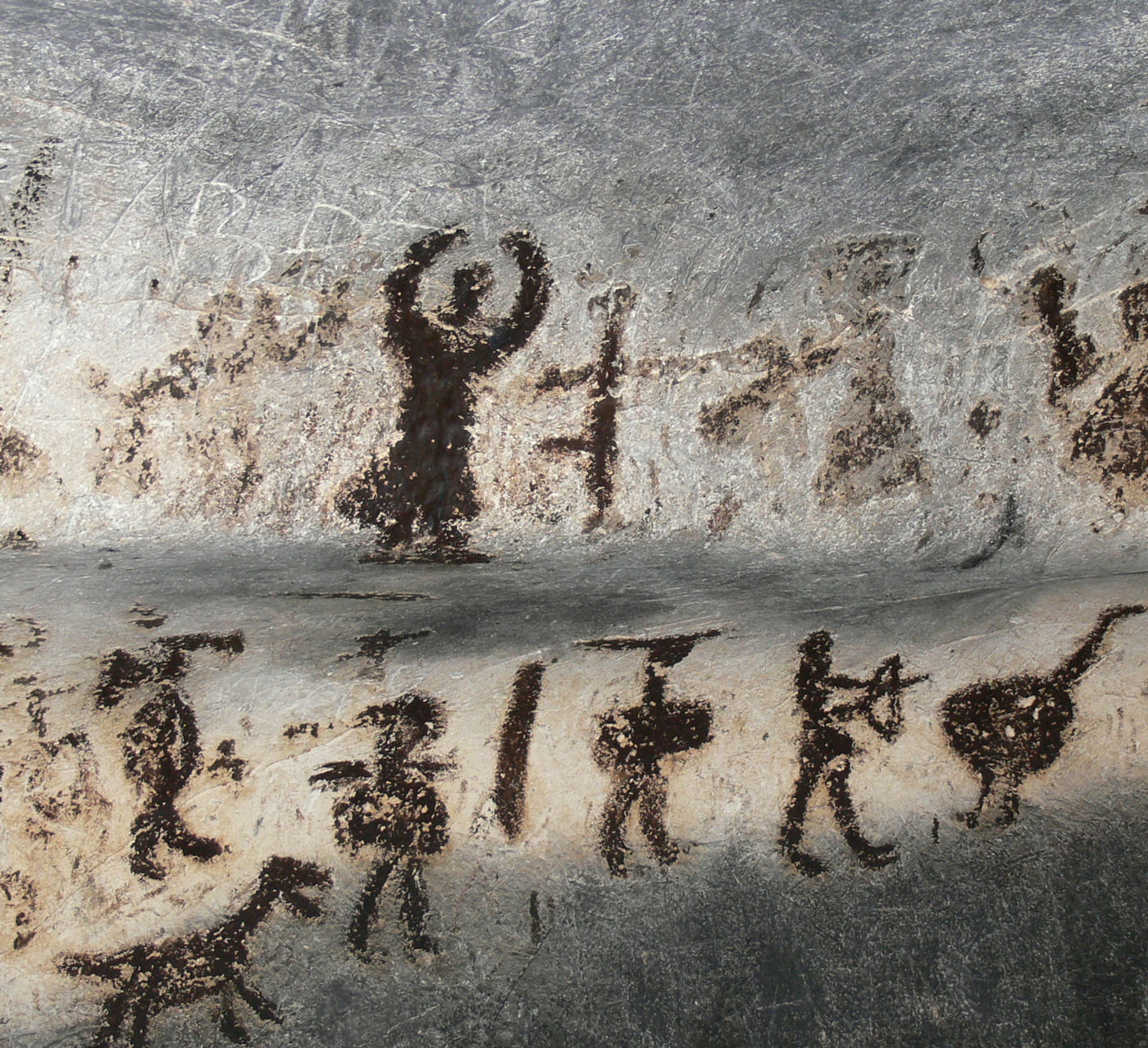
Featured pic: Cave paintings, Magura Cave by MarieBrizard
Subscribe to Freedom anarchist journal, sustain radical publishing and support independent media.
Confessions of a communard: After a Chinese airline kept misspelling my forename during a trip to Australia, I learnt more about naming in different cultures—and decided to make the change permanent