
|
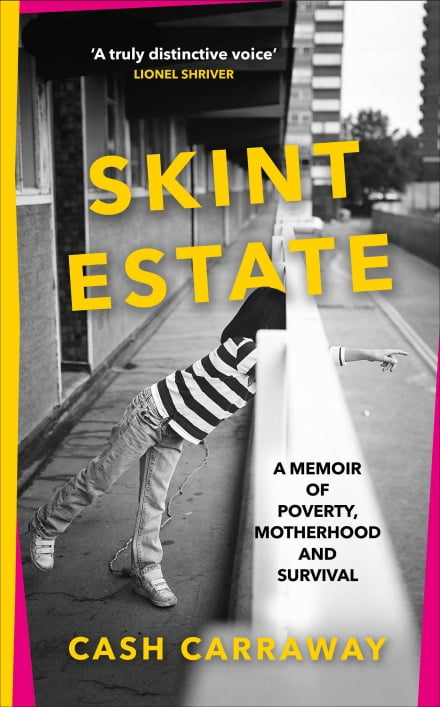
Review: Skint Estate
Rowan Tallis Milligan
8 December 2019
Women like me: Carraway’s memoir of poverty, motherhood and survival is “the most important book on the impacts of austerity I have ever read”, writes Rowan Tallis Milligan.
by Cash Carraway
Ebury Press, 2019
ISBN: 978-1529103373
368pp
£14.99 hardback
This is not poverty porn.
I
ummed and aahhed about writing this book review for a while now. I
have spoken about it with enthusiasm to everyone I know. I have
bought it for people for birthday and Christmas presents. I have
cried and laughed while reading it, sometimes to myself, sometimes
aloud to other people who happen to be in the vicinity. But I
hesitated about writing this review.
Cash
Carraway’s Skint Estate
is the most important book on the impacts of Tory austerity,
particularly on women, that I have ever read. I have read articles in
The Guardian, I have read academic theses, I have read policy
proposals and recommendations and yet none of these bring home
the reality of the loss and the horror of austerity so much as
Carraway’s book.
As a memoir, she
does not shy away from some of the brutish elements of growing up and
living below the poverty line. She details with frank and often
humorous honesty the lengths she has had to go to in order to create
a life for her and her daughter. And yet, as she emphasises time and
again “this is not poverty porn”. For good reason, Carraway is
sceptical of journalists and politicos always looking for a unique
scoop, for an edgy, dirty story they can use to show how gritty and
“real” their journalism is. One of the finest examples of this is
when Carraway is trying to draw media attention to the fact that the
ceiling in the women’s shelter she is staying in has collapsed,
nearly killing an occupant who was thankfully not in her bedroom, due
to its degraded and unsafe infrastructure. She is trying to spread
the word about fatal cuts to women’s services in the same
constituency as, and only a short time after, the Grenfell fire.
She writes that the message they wanted to spread is “this is what
happens to working class women under austerity”. And yet, when the
journalists finally take notice, they ask instead for the women to
describe the treatment they received by men to have ended up in the
women’s shelter, to ask “how many bruises did you have”.
Carraway acknowledges quite rightly that these journalists do not
seek to spread the message of the fatal impact of Tory policies and
how government cuts are harming the most vulnerable members of
society. What they want is poverty porn.
And this is why I hesitated about writing this review. I think
everyone should read this book. I really do. I think middle class
people should read it to understand their complicity in the
subjugation of working class people and to challenge their conscience
if they vote Tory. But they shouldn’t need to. Carraway’s memoir
is personal and affecting, but the impacts of austerity that she
details from her subjective position are not new. This is not news.
We should know by now about the number of people who have died
since the introduction of Universal Credit (UC). We should know that
60% of women who approach a refuge are not able to be offered a place
because of closures, that the government have cut funding to women’s
refuges by 24%. We should know that poor people are being forced out
of the cities and neighbourhoods where they have lived their whole
lives, banished from the capital which is increasingly only for those
with capital. And if you don’t know by now or don’t care
and instead want to cry for a few minutes over such a “tragic
story”, then forget and go on with your life you don’t deserve
to read it. So instead I urge working class people to read this book.
To know they are not alone and that if they are angry they should
be angry. To know, as Carraway says that “is OK to speak out about
the injustices of society without coming up with a solution … it’s
OK to feel unsure and stammer your way through an argument” because
access to real change has been gatekeeped by the middle classes for
too long and, as she reminds us again and again, to change things, to
come up with solutions is a team effort, and she is just one voice
hoping to create change. “How many unheard voices are out there
just like mine?” she asks. “Imagine if we all spoke up together.”
by Cash Carraway
Ebury Press, 2019
ISBN: 978-1529103373
368pp
£14.99 hardback
This is not poverty porn.
I
ummed and aahhed about writing this book review for a while now. I
have spoken about it with enthusiasm to everyone I know. I have
bought it for people for birthday and Christmas presents. I have
cried and laughed while reading it, sometimes to myself, sometimes
aloud to other people who happen to be in the vicinity. But I
hesitated about writing this review.
Cash
Carraway’s Skint Estate
is the most important book on the impacts of Tory austerity,
particularly on women, that I have ever read. I have read articles in
The Guardian, I have read academic theses, I have read policy
proposals and recommendations and yet none of these bring home
the reality of the loss and the horror of austerity so much as
Carraway’s book.
As a memoir, she
does not shy away from some of the brutish elements of growing up and
living below the poverty line. She details with frank and often
humorous honesty the lengths she has had to go to in order to create
a life for her and her daughter. And yet, as she emphasises time and
again “this is not poverty porn”. For good reason, Carraway is
sceptical of journalists and politicos always looking for a unique
scoop, for an edgy, dirty story they can use to show how gritty and
“real” their journalism is. One of the finest examples of this is
when Carraway is trying to draw media attention to the fact that the
ceiling in the women’s shelter she is staying in has collapsed,
nearly killing an occupant who was thankfully not in her bedroom, due
to its degraded and unsafe infrastructure. She is trying to spread
the word about fatal cuts to women’s services in the same
constituency as, and only a short time after, the Grenfell fire.
She writes that the message they wanted to spread is “this is what
happens to working class women under austerity”. And yet, when the
journalists finally take notice, they ask instead for the women to
describe the treatment they received by men to have ended up in the
women’s shelter, to ask “how many bruises did you have”.
Carraway acknowledges quite rightly that these journalists do not
seek to spread the message of the fatal impact of Tory policies and
how government cuts are harming the most vulnerable members of
society. What they want is poverty porn.
And this is why I hesitated about writing this review. I think
everyone should read this book. I really do. I think middle class
people should read it to understand their complicity in the
subjugation of working class people and to challenge their conscience
if they vote Tory. But they shouldn’t need to. Carraway’s memoir
is personal and affecting, but the impacts of austerity that she
details from her subjective position are not new. This is not news.
We should know by now about the number of people who have died
since the introduction of Universal Credit (UC). We should know that
60% of women who approach a refuge are not able to be offered a place
because of closures, that the government have cut funding to women’s
refuges by 24%. We should know that poor people are being forced out
of the cities and neighbourhoods where they have lived their whole
lives, banished from the capital which is increasingly only for those
with capital. And if you don’t know by now or don’t care
and instead want to cry for a few minutes over such a “tragic
story”, then forget and go on with your life you don’t deserve
to read it. So instead I urge working class people to read this book.
To know they are not alone and that if they are angry they should
be angry. To know, as Carraway says that “is OK to speak out about
the injustices of society without coming up with a solution … it’s
OK to feel unsure and stammer your way through an argument” because
access to real change has been gatekeeped by the middle classes for
too long and, as she reminds us again and again, to change things, to
come up with solutions is a team effort, and she is just one voice
hoping to create change. “How many unheard voices are out there
just like mine?” she asks. “Imagine if we all spoke up together.”
The 83rd Estate Agent
There are so many
elements of Carraway’s book I want to pick out, to highlight, to
rant and rave about. Among them: the way in which she analyses the
risk of acknowledging mental health problems for fear of having your
child taken away from you, the feeling of helplessness and failure
when you are forced to use a food bank, when you are uprooted from
where you spent your entire life and shifted to temporary
accommodation in a tiny racist town far from anywhere, the fear of
being nowhere near a hospital and unable to afford a taxi if anything
were to go wrong, of being considered a “bad mother”, the jobs
you don’t choose but you take, you are forced to take, in
order for your daughter to be fed and well, the stigma attached to
benefit recipients and the myths that are propagated about how they
are lazy and entitled and do not deserve assistance, and how those
myths can become internalised. But to see Carraway’s exploration of
those themes, as she delves into them with the openness and anger and
humour that characterises her unique writing style, I urge you
to read the whole book. More than once.
However, one part
I particularly want to focus on is the tale she tells of how she
attempts to find a home in the private rented sector for herself and
her daughter. She moves from estate agent to estate agent, to
Gumtree, to Openrent, to an advertisement in a shop
window offering a free room in exchange for an unorthodox
arrangement. How landlords consistently refuse to rent to someone on
benefits, and a single mother at that. How she is offered a
horrible overpriced flat and pays her holding deposit only for the
landlord to have a “change of heart” and the money not to be
returned. How if she is offered somewhere they expect two
months deposit and six months rent in advance as she is deemed
unreliable and untrustworthy for being a benefit recipient. How it
took her EIGHTY THIRD estate agent before she is offered somewhere.
The reason why I
want to focus on this chapter is because at the end of the day it all
comes down to housing. A home. Carraway makes the same point
at the close of the chapter and I want to quote her in full because
she says it better than I ever could:
“Yes, when times are tough you can swap Sainsbury for Lidl. Luxury for basic. The gym for a jog. Do a ‘no spend’ year. A ‘no spend’ life. Change your energy provider. You can cut back in almost every way. Yet the same can not be said for housing, not if you’re a single mum.” As Carraway points out in her introduction, one in three single parent families live in poverty despite 68% of single mothers being in work. And a huge part of the reason for this is rent. The introduction of the benefit cap and Universal Credit changed housing benefit drastically, with one of the most damaging changes being the streamlining of the “housing element” of UC in line with the “local housing allowance” (LHA). LHA was in theory based on the cheapest 30% of privately rented properties in the area, however, it was frozen in 2016 as part of a surge in austerity policies, while, shockingly, rents kept rising. However, in practice most of the affordable rented properties are already occupied, so a huge amount of people are not having their rent covered adequately by the LHA, leading to increasing likelihood of rent arrears and evictions, contributing to the attitude of landlords to be disinclined to rent to people on benefits. Unlike gender, race, or religion, among others, class or poverty is not a protected characteristic in UK law, therefore there is no legal recourse to challenge landlords who refuse to rent to people on benefits. The Bureau of Investigative Journalism released a report in October 2019 where they discovered that out of the 62,000 two bed properties they mapped across Britain as available to rent, using LHA rates only 5.6% were affordable to people on benefits. If you were lucky enough to be able to afford one of the limited number of properties, the Bureau discovered that out of 180 landlords they contacted, fifty percent said they would not let to anyone on benefits, and most of those who considered it included measures that they did not enforce against other prospective tenants such as asking for six months rent in advance – an impossible request even for a large number of non-benefit claimants. What this means is that people are being forced into increasingly precarious forms of housing: temporary accommodation in their local area if they are lucky, in a different borough or even city if they are a little lucky, and forced into homelessness if they do not match the criteria of vulnerability which councils use to measure whether someone deserves to have a home or not. Those criteria used in homelessness applications state that you must be more vulnerable than the average person seeking assistance, which leads to a sick kind of race to the bottom for the most precariously placed people in society. To bring this back to the book then, Carraway is perfectly aware of this charade of housing assistance, as she moved from precarious private rentals, to women’s shelters, to temporary accommodation both in and out of the city. It took the EIGHTY THIRD estate agent for her even to be given a chance.
Women like me To finish this review, I want to come back to a point Carraway makes again and again throughout the book. Her story is not the only story. She is not the only voice that ought to be listened to. She is part of a vast swathe of people, often women, ignored and trodden on by society. The refrain “women like me” reoccurs throughout her pages, as she sees the effects of Tory austerity impact not only her but other single mothers, other women juggling multiple jobs yet still below the poverty line, other women who escaped domestic abuse and found some solidarity and support in women’s shelters, other women forced to use food banks, other women who would do almost anything to try to protect, and create a better world for the children they love. Sometimes it is used to illustrate the deliberate attempts by the government to remove “women like me” from the city, and at other times it is used to urge for other voices to be raised up as she understands that “change takes flight when we unite together, when we all share our stories without shame and we raise our individual voices collectively”. And as much as others are urged to raise their voices and tell their stories, others of us are encouraged to be quiet, for once, and to listen. But most of all, and why her book is so powerful and her message so clear is in her recognition of the strength and resilience of the “women like me”.
“What I’ve mainly written about is love, and the things that women like me do for the love of their child in a society designed to break them”. Read this book. Get angry. And perhaps one day the collective voices of the previously ignored will be heard. And together, we will be able to change things. ~ Rowan Tallis Milligan
Class
Freedom
Bookshop
Austerity

Why the abuse of benefit claimants is hurting all workers
“I would have quit this job months ago, but I’d be sanctioned by the Jobcentre”. That’s what one friend told…
SolFed
New In






Freedom Press

Subscribe to Freedom anarchist journal, sustain radical publishing and support independent media.
SUBSCRIBE
AND DONATE
Latest
Churchill vandalism case win, and thoughts on masked fash
Anarchist News Review: Andy, Tab and Simon hail some good news for pigeons as a jury throws out the infamous Churchill statue vandalism case.
Freedom News
|
18 September 2026

Autistici/Inventati: “We need 1,000 more infrastructures of dissent to be born”
Interview with the Italian digital collective, de-banked and shut down after US “terrorist” designation
Gabriel Fonten
Browse over a century of anarchist commentary and reporting from the Freedom digital archive
EXPLORE THE
Archives