The document does not establish whether or not all the groups or actions, as can be inferred, are committed by cells of larger organisations that in other attacks have used different names.
In the past eight years the most active insurrectionist anarchist groups have been, according to the document prepared by CISEN: the Earth Liberation Front, with 52 direct actions, The Animal Liberation Front, with 44; The Autonomous Cells of Immediate Revolution Práxedis G Guerrero (CARI-PGG), with 32; the Informal Anarchist Federation with 30; and among others the Conspiracy of Cells of Fire, with 12.
As a group, the CARI-PGG were disbanded in November 2013. However they remained active for almost five years. As stated in a 2016 communiqué, those who joined them stopped acting as CARI-PGG but individually and as other groups, continuing the insurrectionist anarchist attacks and direct actions.
Some of the actions in this anarchist tendency have been carried out in coordinated attacks by two or more groups. Mexico City has experienced the highest number of attacks: 91. Other states with more than 10 direct actions committed by insurrectionist anarchists from 2008 to date are The State of Mexico [3], and Jalisco, with 16. Between one and nine direct actions have occurred in Oaxaca, Baja California, Guanajuato, Veracruz, Coahuila, Durango, San Luis Potosí, Quintana Roo, Chihuahua, Querétaro, Hidalgo, Nuevo León, Tlaxcala y Puebla.
Attacks against universities and research centres
In a response to Contralínea, CISEN emphasised that “the term anarchist is not specified in current Mexican legislation. It also says that the agency “does not attribute the claim of attacks to any individual or group identified by their ideology.”
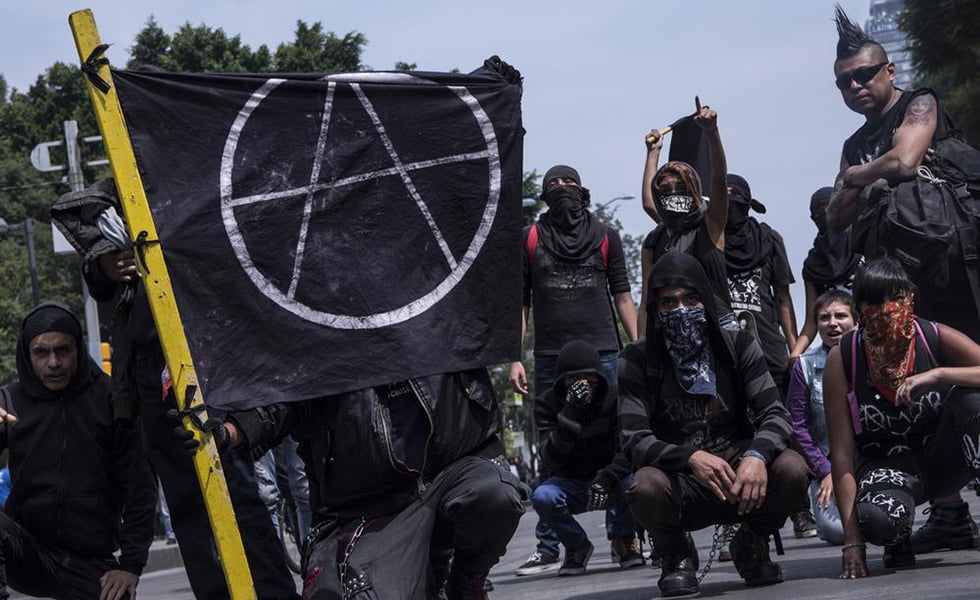
The institute for protecting national security persecutes “violent groups.” “It is the objective of any authority to contain violent acts, a situation unrelated to ideologies.” This is what they highlighted in the response to the request for public information. But, in the National Risk Agenda anarchism is denounced in general, even those anarchists who don’t claim to be of the insurrectionist tendency. In the section about the “vulnerabilities” of the Mexican state, they highlight “the lack of a legal framework to limit the organising of anarchist groups.” This consideration denotes a “medium” level of risk. Anarchist organising of any type is now under the magnifying glass of national security.
In addition, the document considers groups as anarchists that aren’t anarchist—and are even opposed to anarchism, such as Individualists Tending towards the Wild (ITS) [4]. This organisation has claimed the assassination of administrative workers, scientists and attacks against the university and centers of study.
However, the Agenda points out that: “anarchist cells slowly increase their levels of radicalism, particularly that of ITS, which has threatened attacks against human objectives.”
Even attacks by insurrectionist anarchists are not distinguished from those attributed to other post-modern groups like ITS and other related groups that have claimed to be anti-civilisation, like Wild Reaction. [5]
There are also examples of fascist or neo-Nazi organizations, like Tenochtitlan Salvation Front and its Secret Organisation of Leaders of Tenochtitlan who say they are trying to restore the “sacred” “Aztec nation” and “put in power” those who would “guarantee the protection of the natural rights of the human species”.
Overall, for the military and the intelligence communities, all of these groups are “anarchists” and labelled as such. And in the General Diagnosis it is highlighted that “attacks against banks, institutions and individuals linked to research centers and direct actions against human targets with terrorist links are to be expected.”
It also states that “members of anarchist groups operate together as attack groups during social moblisations.” Among the “risk scenarios” envisioned by the National Risk Agenda they point out the “possibility of direct actions with high impact: bombings and explosions against human targets, and the expansion of anarchist groups due to the lack of a legal framework to coordinate against specific anarchistic threats.” This situation leads to another, equally considered “risk scenario”: the “negative impact on perception of the citizen security brought on by the reactivation of (anarchist) groups.”
A coming strike against the anarchists
In regards to the “capacities” of government entities to confront these insurrectionist anarchists, the National Risk Agenda highlights “inter-institutional intelligence work: Sedena, Semar, Segob, in the zones of (anarchist) attacks” (sic).
Among the “recommendations” of the National Security Council contained in the National Risk Agenda are: “strengthening the inter-institutional scheme to address (anarchism)”, as well as the “relaunching of operative groups within CISEN focused on specific objectives” (sic).
The operating groups are, in the words of the intelligence services, those who are in charge of specific special missions: for example, covert actions, follow-ups, infiltrations, for home invasion or that of an institution for surveillance. In some countries the operational groups are tasked with the elimination of those who make “attempts” against the “security” of the State.
Insurrection in the middle of the country
The National Risk Agenda recognises the presence of anarchist “direct action” cells in five regions of the republic: Mexico City, the State of Mexico, Morelos, Oaxaca and Baja California. In the first three regions mentioned there are anarchist collectives. In Oaxaca anarchists are found in State capital and in the fringes of the Central Valley, Sierra Norte and Sierra Sur. In Baja California they are listed as being in the city of Mexicali. However among the list of direct actions by insurrectionist anarchists presented by CISEN, 17 of the 32 regions of the Republic are counted: Mexico City, the State of Mexico, Jalisco, Oaxaca, Baja California, Guanajuanto, Veracruz, Coahuila, Durango, San Luis Potosí, Quintana Roo, Chihuahua, Querétaro, Hidalgo, Nuevo León, Tlaxcala and Puebla.
National security: The rise of anarchism
Up until the 2013 version of the National Risk Agenda, anarchism has been considered one of the top 10 immediate issues for national security, and was then raised to fifth, ranking it as a form of guerrilla warfare. This places them in the company of armed movements such as the Zapatistas (EZLN), el Ejército Revolucionario del Pueblo Insurgente (ERPI), el Ejército Popular Revolucionario (EPR) and, among others, the Tendencia Democrática Revolucionaria-Ejército del Pueblo (TDR-EP). All these appear together with insurrectionist anarchist cells in a single chapter of the confidential document at the hands of the Interior Secretary in charge of CISEN.
In 2014 anarchism was assigned an independent section and put into fourth place — the guerrilla movements remained in fifth. Then last year the National Risk Agenda, due to insurrectionists’ actions, bumped the anarchist threat level to third priority for civilian and military institutions in charge of defense and national security: Sedena, Semar, the CISEN, the Segob, the PGR, and among others, the Federal Police. The anarchist insurrection increased in focus, while the red guerrilla groups’ priority level fell dramatically.
From boycott to armed confrontation
According to the information collected by Contralínea – from libertarian distribution portals, among which Contrainfo stands out – insurrectionist anarchist groups and cells performed more than 20 direct actions against specific targets between May 2015 and September 2016. The actions ranged from boycotts to armed confrontations. The spectrum of acts include sabotage, attacks, placement of fake bombs, detonation of explosives and fires. These are only the direct actions that are documented. The real number is difficult to project because not all acts are claimed. Generally, the police don’t tell the media of possible insurrectionist anarchist attacks.
The most recent coordinated attacks were the work of Grupo Autónomo de Sabotaje Salvador Olmos García. On July 3rd, they setup and detonated an explosive-incendiary packages at the headquarters of three of the main Mexican business organisations.
Salvador Olmos García is the name of a young anarchist, organiser of indigenous neighborhoods, punk singer, lawyer and local journalist who was assassinated by police in Huajuapan de Leon, Oaxaca, on June 28th. Olmos had been apprehended by police earlier that day, when he had responded to a call by the community radio Tuun Ñuu Savi to help defend the space from police eviction. Chava was arrested by a police patrol and beaten. This event caused activist groups all over the state, and even, several entities throughout the Republic to react and five days later came the attack on high-level agencies.
The Contrainfo website has reported attacks against the Ciudad de México del Consejo Coordinador Empresarial (CCE), the Confederación Patronal de la República Mexicana (Coparmex) and the Cámara Nacional de la Industria de la Transformación (Canacintra). In all:
There is no possible solution for the oppressed within the margins of their institutions, without the uncompromising struggle against capital and the State, that makes possible a scenario open to general insurrection [and] that establishes a dialect of spontaneity and organization, social peace in the Mexican region and throughout the globe.
Death to the State and Capital!
Freedom for all poltical prisoners!
For Anarchy!
“Grupo Autónomo de Sabotaje Salvador Olmos García”