
|
The miseducation of Andy Burnham
Radical Reprint: Britain’s PM wants a more ‘relevant’ education system. We go back to 1959 to show when it comes to capitalist education, it’s the same as it ever was
punkacademic
2 August 2026
Britain’s new Prime Minister Andy Burnham has been sounding off about a number of things in his first weeks in office – not least education. Last week, No 10 announced that there was to be a major shake-up in British secondary education, with (in Andy’s words) “new technical education pathways from 14—prestigious routes that will give students the chance to combine the core academic subjects with the skills, technical knowledge and experience they need to get quality, well-paid jobs where they live”.
The problem, as every educator with even a little experience knows, is that it’s all been said before. You can go back as far as the nineteenth century to find employers whinging in the press about the decline of apprenticeships and the need for government to do something, but even in the last four decades we’ve been blessed with everything from BTECs to NVQs to T-levels.
Put bluntly, every initiative to put technical education on the same level as ‘academic’ education has failed. PM Andy intones emphatically that “from today, Britain will value the hard hat every bit as much as the graduation cap”, but saying it, as Prime Minister after Prime Minister has done, doesn’t make it so.
Why is that?
A well-known aside in educational circles which sums up the issue pithily is that for politicians, technical or vocational education is always the answer to the problem… for someone else’s children.
As the sociologist Sol Gamsu showed recently, the politicians who make education policy would never themselves have taken such a route. Burnham represents change insofar as he’s the first Prime Minister to graduate from Cambridge since before the Second World War.
The reality is prosaic. Britain remains dominated by a power elite forged in a select group of institutions (public schools and ancient universities). The kind of education Burnham’s on about isn’t for the ruling class, but for the rest of us.
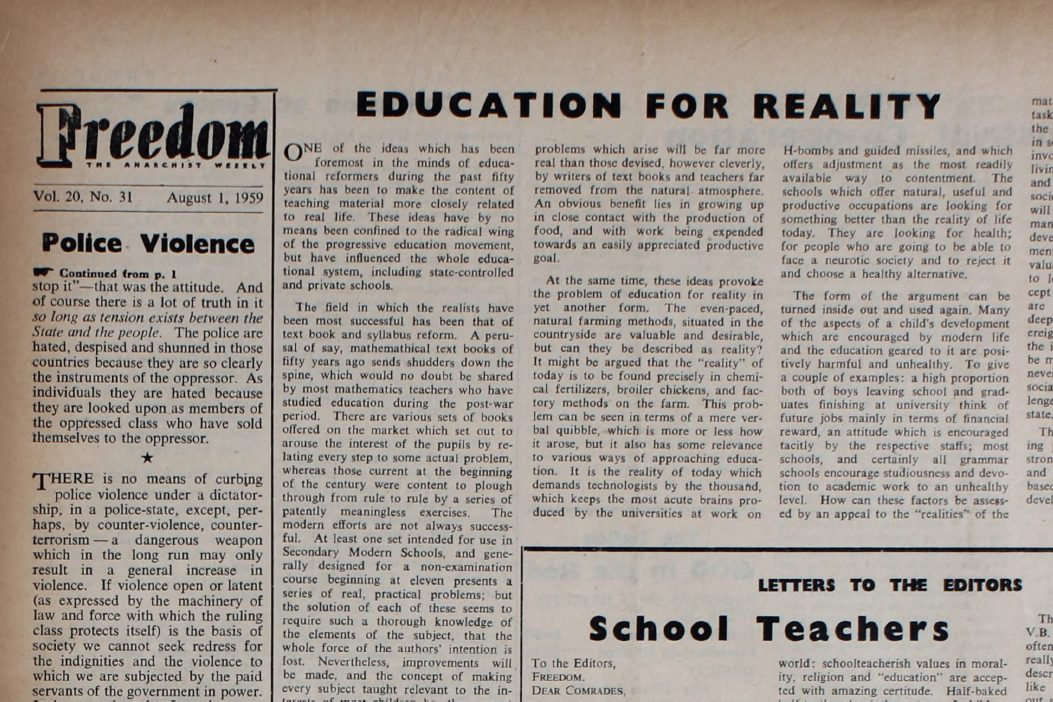
In the piece reprinted below from 1959, ‘P. H.’ takes aim at the government’s obsession with trying to foist a certain version of ‘reality’ upon education. The piece is of its time, and some of the language and sentiments wouldn’t be ours (not least the gendered perspective). But the point made—that state education is fundamentally about fostering conformity—remains valid.
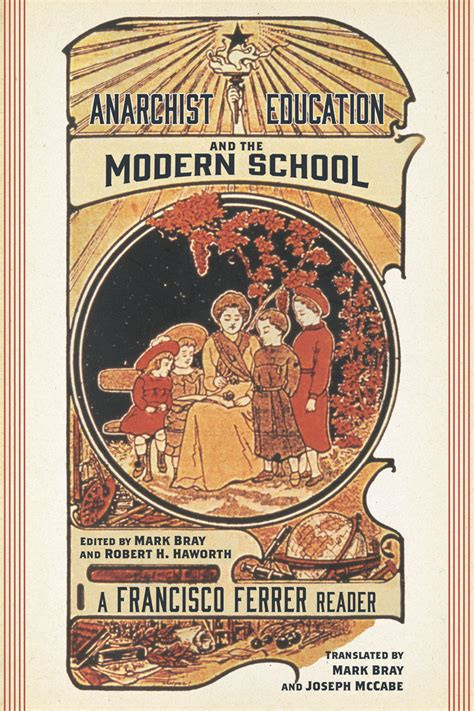
Anarchists have a long and noble tradition in terms of educational experimentation beyond the confines of the state, from the anarchist communist Sunday schools of the turn of the last century through Francisco Ferrer’s modern school movement to more recent examples of authentic free schools in the 1960s. Colin Ward wrote extensively about schools (his Freedom essays on the subject were reprinted as Talking Schools) and Michael Duane, the former headteacher of Risinghill Comprehensive School (which he attempted to organise on non-hierarchical lines), published a number of pamphlets with Freedom Press.
As our predecessor writes below, the state education system is fundamentally anchored in the dictates of capitalism. That education exists for the individual to gain a ‘good job’ and earnings is now an axiom, reinforced in universities through payment of fees. The ongoing destruction of humanities departments represents not just cost-cutting, but an attempt to smash what limited critical space is available within formal education. Burnham’s staff have already briefed that saving the humanities in universities isn’t high on his agenda.
As ever, Burnham’s words are just code for capitalist common sense. And, as ever, it’s helpful to remember that this common sense isn’t ours, and a long and noble tradition of alternatives exists offering a very different kind of ‘relevant’ education.
(from Freedom vol. 20:31, 1 August 1959)
Education for Reality
One of the ideas which has been foremost in the minds of educational reformers during the past fifty years has been to make the content of teaching material more closely related to real life. These ideas have by no means been confined to the radical wing of the progressive education movement, but have influenced the whole educational system, including state-controlled and private schools.
The field in which the realists have been most successful has been that of text book and syllabus reform. A perusal of say, mathematical text books of fifty years ago sends shudders down the spine, which would no doubt be shared by most mathematics teachers who have studied education during the post-war period. There are various sets of books offered on the market which set out to arouse the interest of the pupils by relating every step to some actual problem, whereas those current at the beginning of the century were content to plough through from rule to rule by a series of patently meaningless exercises. The modern efforts are not always successful. At least one set intended for use in Secondary Modern Schools, and generally designed for a non-examination course beginning at eleven, presents a series of real, practical problems; but the solution of each of these seems to require such a thorough knowledge of the elements of the subject, that the whole force of the authors’ intention is lost. Nevertheless, improvements will be made, and the concept of making every subject taught relevant to the interests of most children has the support of Ministries, authorities, and quite a large part of public opinion.
A parallel movement, also most strongly felt in non-examination schools, is the emphasis placed on woodwork and similar crafts, which are coming in some schools to be regarded as important subjects in themselves, and not just time-filling pastimes, for the ungifted.
However, it is difficult to assess the nature of reforms such as these. They make life more pleasant for pupils and teachers, and take some of the fear and drudgery out of school and learning. They involve no essential revolution in the ideology of education, nor do they undermine its function of producing conformist citizens. Just as the development of state welfare services makes life less hard for people who suffer misfortunes or ill-health, but at the same time binds them more tightly to their positions of subservience in society, so do the reforms in the educational system bolster it up in its character moulding role, and skim off a certain layer of its opponents.
However, some schools try to go beyond the limits placed on those within the slate system. One school in Scotland is well known for having a farm closely linked with its activities, and insists that the farm is an integral part of the school in which everyone participates and not just something tagged on as an extra. The headmaster, speaking at a recent meeting in London, emphasised the idea that one of the benefits of the farm lay in the easy pace of activities which it encouraged, in contrast to the inhuman rush of modern life, and that he was particularly interested in its being a real farm, and not one of the “factories in the country” which are springing up nowadays. The value of such an environment to a child who might otherwise be living in a city is clear, and the problems which arise will be far more real than those devised, however cleverly, by writers of text books and teachers far removed from the natural atmosphere. An obvious benefit lies in growing up in close contact with the production of food, and with work being expended towards an easily appreciated productive goal.
At the same time, these ideas provoke the problem of education for reality in yet another form. The even-paced, natural farming methods, situated in the countryside are valuable and desirable, but can they be described as reality? It might be argued that the “reality” of today is to be found precisely in chemical fertilizers, broiler chickens, and factory methods on the farm. This problem can be seen in terms of a mere verbal quibble, which is more or less how it arose, but it also has some relevance to various ways of approaching education. It is the reality of today which demands technologists by the thousand, which keeps the most acute brains produced by the universities at work on H-bombs and guided missiles, and which offers adjustment as the most readily available way to contentment. The schools which offer natural, useful and productive occupations are looking for something better than the reality of life today. They are looking for health; for people who are going to be able to face a neurotic society and to reject it and choose a healthy alternative.
The form of the argument can be turned inside out and used again. Many of the aspects of a child’s development which are encouraged by modern life and the education geared to it are positively harmful and unhealthy. To give a couple of examples: a high proportion both of boys leaving school and graduates finishing at university think of future jobs mainly in terms of financial reward, an attitude which is encouraged tacitly by the respective staffs; most schools, and certainly all grammar schools encourage studiousness and devotion to academic work to an unhealthy level. How can these factors be assessed by an appeal to the “realities” of the matter? It could be argued that the task of a school is to give every child the best possible chance to make its way in society as it is. The alternative choice involves recognizing that as it is, we are living in a society of widespread misery, and that to pursue the goals which that society sets before its children and youth will in most cases involve repressing many of the healthy aspects of their development. If happiness and development are really the objects which people value most highly they must be prepared to look for a more revolutionary concept of reality than the solid majority are at present likely to accept. Every deep movement towards individual sovereignty, and every attempt to force the issue that social organization should be made only to suit the individual, and never should people be moulded into the social organization, represents a challenge to the stability of authority and the state.
The reality which anarchists are asking people to accept is that the more strongly we can strike against authority, and deny the ideology on which it is based, the more free will people be to develop their personal lives in happiness.
P. H.
Subscribe to Freedom anarchist journal, sustain radical publishing and support independent media.
Share
Education


Latest
The legacy of Mikhail Bakunin
His social conflict analysis, naturalist materialism, and organisational dualism continue to inspire
Felipe Corrêa
|
28 July 2026

The Case of the Spinning Judge
Imagine what it feels like to sentence war resisters as terrorists
Tabitha Troughton
Subscribe to Freedom anarchist journal, sustain radical publishing and support independent media.
SUBSCRIBE
AND DONATE
New In





Freedom
Bookshop
Education
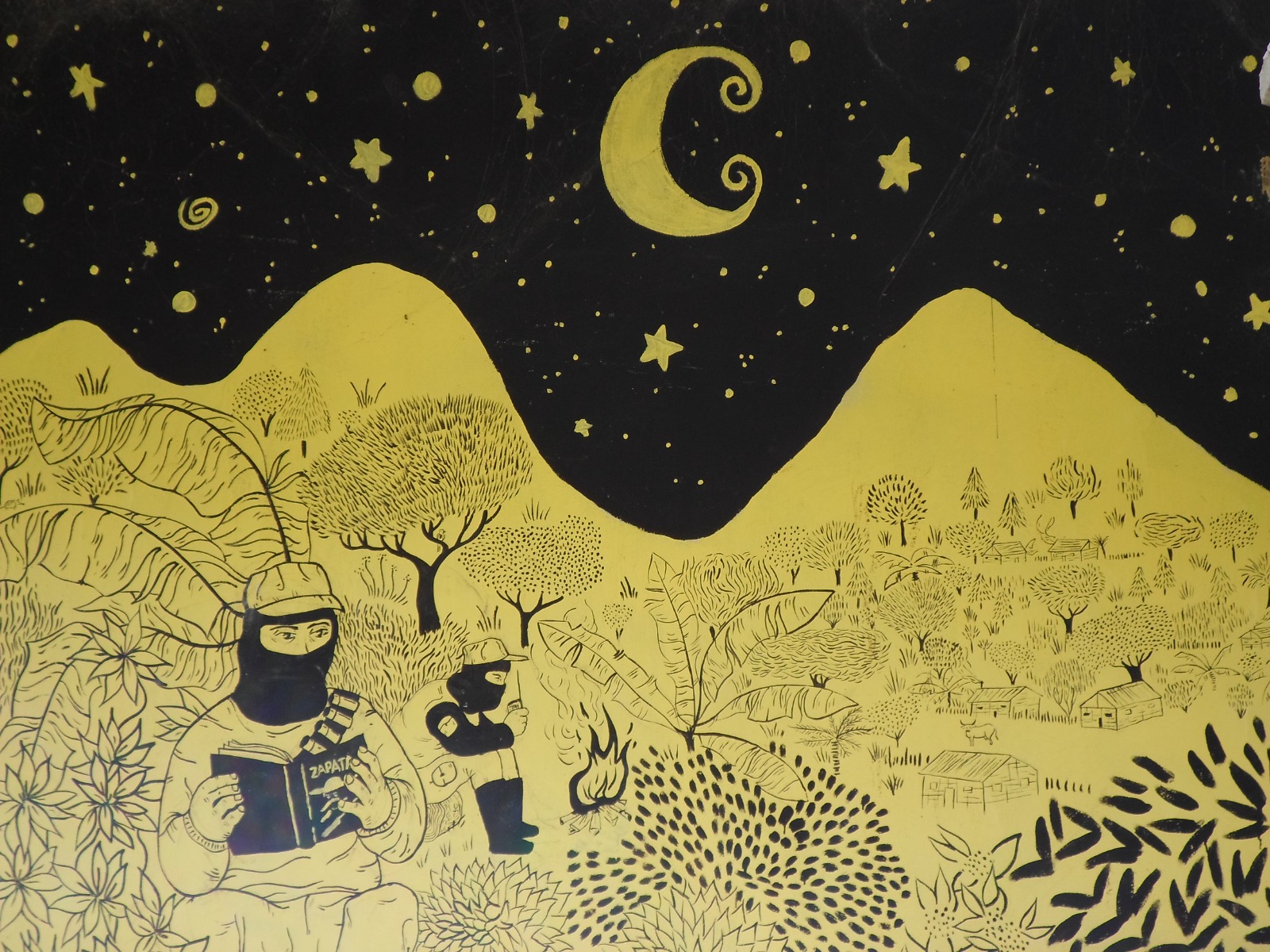
Education and autonomy in times of ecological collapse
Zapatista education promotes a relationship with knowledge based on the needs and questions of students and communities
Ana Paula Morel
Freedom Press

Browse over a century of anarchist commentary and reporting from the Freedom digital archive
EXPLORE THE
Archives