
|
Who’s afraid of the Black Vests? The Gilets Noirs and the struggle for migrant rights in France
Staz
1 February 2020
On the 23rd November 2018, the Immigration Museum in Paris was occupied
by 300-400 people, convening a general assembly on the oppression faced by
migrants in France. Out of this gathering emerged what is now known as the ‘Gilets
Noirs’; a political movement which brings together undocumented migrants – many
of whom are taking political action for the first time – and experienced campaigners
involved in La Chapelle Debout
and organising in the overpopulated foyers
(hostels for migrant workers). News of this new group spread quickly, both on
social media and through word-of-mouth in the foyers, and only a few
weeks later, roughly 700 Gilets Noirs occupied the Comedie Francaise, demanding
a meeting with the prefecture to obtain regularisation.
It’s worth reflecting on the situation faced by undocumented workers in France.
Technically, employers can support someone’s application for regularisation,
but this would require them to pay fair wages and make social security
contributions. The situation isn’t helped by the monstrous French bureaucracy
that seems purpose built as an homage to the film Brazil (although people who have dealt with the UK Home Office will
doubtless have had similar dystopian experiences). Meetings to discuss
regularisation are often postponed or cancelled at the last minute, corrupt
officials will hint that they can speed up the processing of your file for a
few hundred euros; bosses firing you as soon as you ask them for help in
obtaining papers; being forced to live in a tent in the dead of winter or sleeping
4 or 5 to a bed in a single occupancy room rented out by Adoma (one of the
companies which run the foyers),
which profits from your misery; getting arrested after a “random” police stop
and sent to a detention centre; poorly paid jobs on building sites with no
safety regulations; receiving a deportation notice; getting sent to a detention
centre again and finally the waiting room for deportees near Terminal 2 at
Charles de Gaulle Airport, or the basement of the 4-star Ibis hotel next door.
In many ways, the Gilets Noirs are merely the latest incarnation of the struggle
against this cycle of barbarity. It’s a movement that has a long history in
France, which has adopted a wide variety of forms and tactics over the years. But
many participants speak of having always felt like their struggle was
artificially separated from other left-wing causes, despite its obvious links
to struggles around housing and exploitation in the workpace, which also affect
those with papers. The movement has also had to contend with the referential
breadth of the category of ‘the migrant’, which can refer to people in a wide variety
of administrative categories: documented, undocumented, those with right remain,
those fleeing deportation, legally-recognised workers, undeclared workers etc.
The establishment of the Gilets Noir gives the movement an identity without
reducing it to that of the administrative status of its participants.
The name ‘Gilets Noirs’ was adopted by around the time of the Comedie
Francaise occupation as a way of integrating the struggle of migrants with that
of the nascent Gilets Jaunes. Although the Gilets Jaunes had not declared
themselves to be acting in solidarity with migrants (indeed some early Gilets
Jaunes actions were clearly supported by the far right), many of their (successful)
efforts to blockade airports, motorways and roundabouts, helped migrants by
temporarily shutting down the deportation machine.
Things moved quickly: after the occupation on the 16th December, the
prefecture agreed to an initial meeting, to which some 1500 people turned up.
The prefecture responded by closing its doors and calling in riot police. We’re
all familiar with the stance taken by officials and bosses when dealing with
collective movements and strikes: “we are happy to discuss with you all
individually in order to find a solution”. In other words: “it’s
easier to defeat you on a one-to-one basis because when you’re in front of us,
without your mates and comrades it’s obvious where the power lies”.
Migrant movements have seen similar responses from authorities. When these
migrants finally came out into the open, the prefecture agreed to assist in the
regularisation of 30 people each month (out of more than 1000 participating in
the movement). But as of yet not a single case has been resolved.
Gilets Noirs actions attack the big businesses that profit from
exploiting undocumented workers or participate in the wider deportation machine,
including those involved in major public infrastructure. For example, GN staged
an ‘invasion’ of Charles de Gaulle Airport, in which 500 or so migrants
descended on the airport “not
to clean but to fight!” The action was the first in a series of actions
dubbed “Gilets Noirs hunt down the Prime Minister”, which sought to
confront officials at the highest levels of government with the injustices of
the immigration system. From here the GN went on to target businesses that
actively profit from the continued precarity and oppression of undocumented
migrants, including Elior, a catering and cleaning business that employs
undocumented migrants to work as cleaners and cooks in detention centres (and
who also hold catering contracts for the Ibrox stadium and St Alban’s
Cathedral, among others!). On the 12th June 2019, Elior’s corporate
offices were occupied by several hundred undocumented migrants demanding that
the company assist its employees with regularisation. The occupation only
ended when the occupiers were given a written assurance that a meeting would
take place between company representatives and undocumented activists, to see
how Elior can help regularise their immigration status. However, at the time of
writing, Elior have half-heartedly helped only 10 of the 200 undocumented persons
working for them obtain the CERFA documentation necessary for their
regularisation, while a further 3 were fired. Failure to meet the GN’s demands
led to another action the 3rd of December 2019 in collaboration with
CNT-Workers Solidarity at the flagship Nespresso store in Paris-Opera.
A state crackdown was inevitable, and on 27th of November 2019, the
police arrested GN activist, Diakité, who was (temporarily) held at a detention
centre at an infamous detention centre in Vincennes, where another migrant,
Mohammed, had died some three weeks earlier.
In spite of this, the Gilets Noir continue to push for the
regularisation of all undocumented migrants in France. What’s more, they do so
while maintaining a horizontal organisational structure that works with –
rather than against – the political, cultural and linguistic diversity of its
members. This is not without its challenges, but all members are expected to
respect the group’s strategic decisions and the tactics decided upon in general
assemblies. As a result, where once many undocumented migrants were afraid of
participating in political action for fear of arrest and deportation, they are
now coming out in their hundreds to confront the people responsible for their
repression. Long may it continue.
For updates on the Gilets Noirs’ latest activities, check out their Facebook page (mostly in French).
Staz
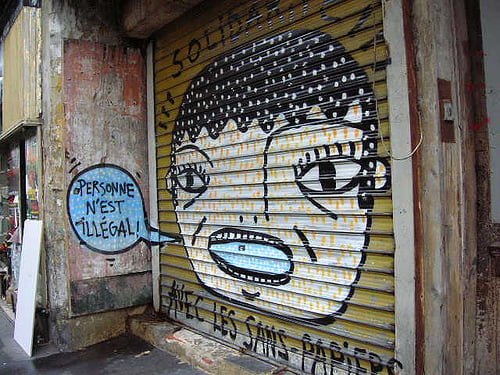
Photo Credit: Gilles Klein on Flickr used under CC BY-SA 2.0
Freedom
Bookshop

New In















Freedom Press













Subscribe to Freedom anarchist journal, sustain radical publishing and support independent media.
SUBSCRIBE
AND DONATE
Latest
Greek prisoners release: Selective American condemnation is telling
Two long-term prisoners were released in Greece this week: a prominent neo-nazi leader, and an anarchist. Only one of the two was singled out by the US ambassador.
Neil Middleton
|
19 September 2026
“To make the Earth a Common Treasury”
Marking 350 years since the death of the English revolutionary Digger Gerrard Winstanley (1609-1676)
Robert Graham
Browse over a century of anarchist commentary and reporting from the Freedom digital archive
EXPLORE THE
Archives