Back in the growing winter of 2016 a pack of punks, anarchists and incorrigible rogues met in an indescript nonspace above an anarchist bookshop in East London with a dog, some beers, and a plan. The intention was to set up an autonomous DIY venue and social centre – something that used to be common in London, but since the squatting ban had struggled to sustain.
George F.
|
24 January 2019
Its first incarnations moved through an old bank, an abandoned bookshop, a Costa coffee, whatever space could be expropriated for radical fun. The crew mutated as the buildings did, but a common thread of punk, autonomy and politics ran through, with benefit parties and infonights held for imprisoned anti-fascist fighters, anarchists and hunt saboteurs. Eventually the circus pulled up in Noah’s Ark, which for the best part of a year played weekly host to the crustpunkscum of London, until it was evicted in the summer 2018.Against this backdrop of noise-terror, amphetamine and Karpackie, a clan of women and nonbinary punks began to organise to challenge the macho hetero-patriarchy of the underground scene, and to fill in some of the collective blanks in the culture. One of these is documentary photographer and one of the founding members of the LAD$ CollectiveJude Kendall. We caught up with her at a skate-park punk show and shouted at each other about photography, death, punk and dickheads.
GF: Why are you
documenting London’s punk scene?
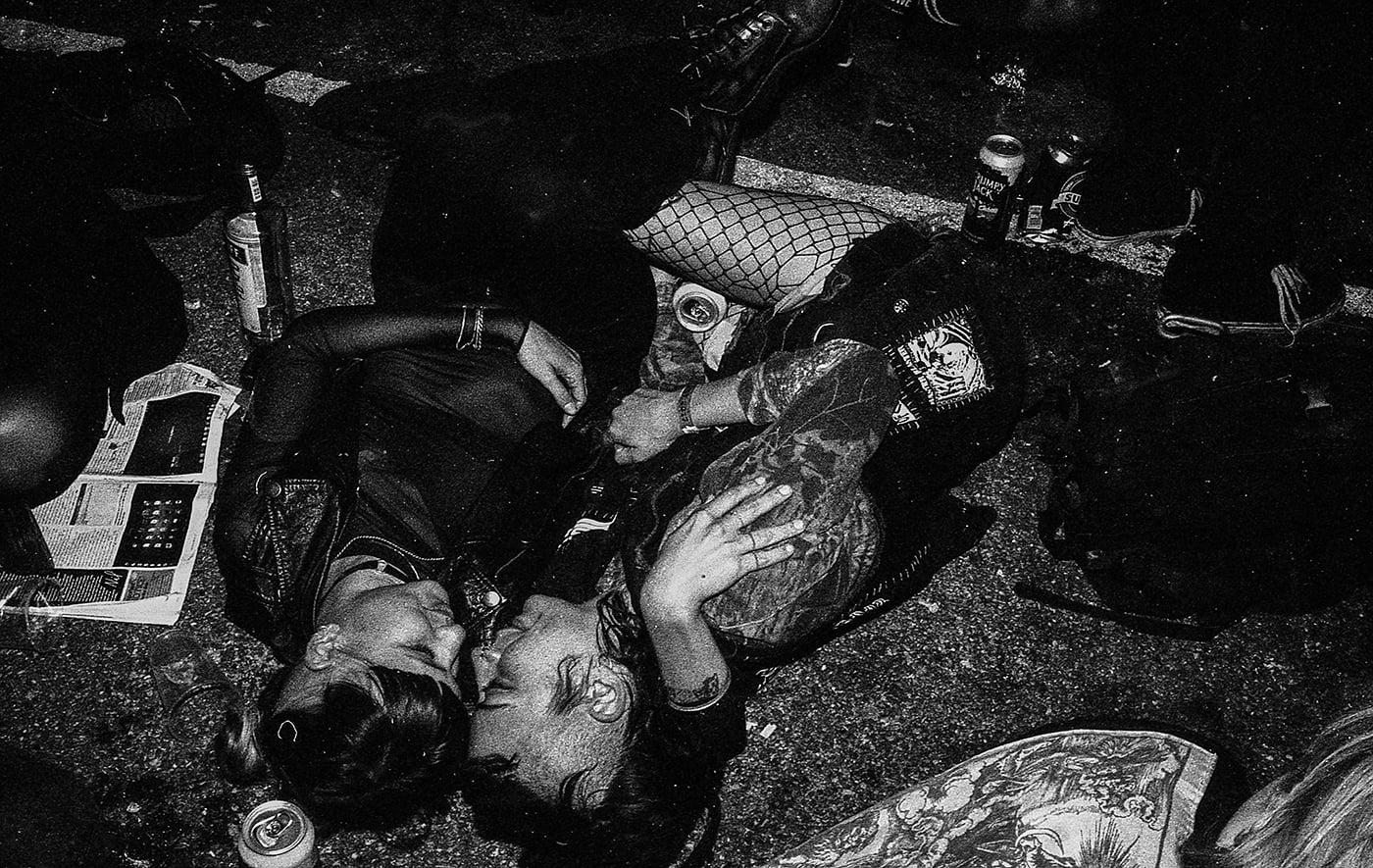
JUDE: What immediately springs to mind is “because I can”. I hope that by documenting punks the way that I do, less visible people in the punk scene become the focal point. There’s a lot of photos of bands and people onstage, some great, some not so. Depressingly, this is still often men. It reinforces a feeling that lots of people I’ve spoken to experience, that if you’re not a promoter, or in a band, or do sound, or whatever then you’re not as important as others. Everyone knows the cliche of all the fun of a punk show being outside in the car park or on the street, and so my photos are a bit of a rounder picture of the scene rather than just watching bands.
I was very tentative about taking people’s pictures at
first. I’m still quite shy of it because no one should feel obliged to have
their photo taken by someone if they don’t want to. The phrase “take”
a photo also implies that making a picture of someone, you are owning a part of
them, which sits a bit uncomfortably with me. There’s a tension between being a
participant in a group and then putting a lens between your friends and yourself,
so I don’t tend to take loads of pictures on any one particular night because
otherwise constant camera flashes piss people off and I think I’d use up
people’s goodwill a bit too quickly. One of the differences between participant
and outsider documentary photography is I feel it’s way more ethical – like
you’re collaborating with the people you’re photographing rather than
exploiting them for your own personal gain, therefore the images have a greater
intimacy and realism too them. Additionally to this, my photos show all the
happiness and madness in the punk scene, and people’s relationships with one
another. The tricky thing means there are also moments that I recognise would
be visually great, but I just couldn’t take the pictures and not feel horrible.
The other reason I could think of is to do with photography
and death. If you’re taking pictures, particularly on negatives, which are
tactile objects, then you’re freezing a moment that otherwise would be
forgotten. So I guess it’s a bit of a fear of being forgotten. Roland Barthes
wrote a lot more about death and much more cleverly than I’m explaining here,
but in short that’s the idea.
GF: Tell us about the
people you are photographing? Who are they and what’s the situation?
JUDE: The people I’ve photographed have changed and developed since I started. I feel like I’m the ghost in each of the pictures because my picture alludes to where I am and what I’m doing. That said, those I photograph the most tend to be my closest friends – partly because I love photographing them but also I’m with them the most. Many of them are squatters. Pub gigs are less fun to document after you’ve had your camera out at a DIY tattoo night, or party in a weird abandoned building.
Ktown Girls
GF: Tell us about the
LAD$ collective. How does that fit in?
JUDE: LAD$ Collective is a group of outsiders who make art,
poetry, statements and whatever. We make a zine. Me and my friends Lisa and
Amandine (the latter of Poisonous Cunt) came up with the idea of forming
our own collective after going to a zine fair in 2017. We thought it’d be
really cool to actually team up with all the many artists and writers we knew.
It’s a lot easier to ignore one person than a big group.
For me personally, I think it started before that. I’d been
part of the Minesweeper collective for a few years and always wanted something
like that but with the women punks I knew. I think if you’re an artist and you
don’t have connections or family money, then you need to be part of a
collective or art scene for strength in numbers. In February last year
Poisonous Cunt played their first show in the Wandsworth squat and it was
deeply inspirational to see female friends of mine who I’d known for years as
drinking buddies and mates taking themselves onto a stage. The response from
women in the crowd was amazing, suddenly the front of the pit was women, not
because they’d be invited “girls to the front” style but because they recognised
it as their own space. Another reason we made LAD$ was because for many of us
when we started to be involved with the punk scene, it was despite the creepy
old men and dickheads. A common experience for young men seems to be older
punks looking after them and in a way mentoring and encouraging them. I don’t
know any women who had this experience, it was predominately being creeped on
until you got a boyfriend. I would really like to think that by LAD$ existing,
we have created a community where younger people coming into the scene can meet
people without being harassed or viewed as a possible girlfriend or fuck.
Noise Complaint
In terms of my work fitting in with the collective,
obviously we’ve made a great platform for ourselves and for others to get our
work out there. I think there can be a bit of shame associated with promoting
yourself as an actual artist but with LAD$ I figure if one person manages to do
well and make some money out of what they do, it’ll probably provide
opportunities for everyone and that’s the point right?
The only downside of being so involved with the collective
means I’ve not had much time for anything else this last year, but luckily I
take most of my pictures when I’m out and about socialising, so it’s a pretty
easy thing to fit in, and with the zine I’ve got somewhere to put my newest
photos rather than saving everything for a book.
GF: Who are your
influences and inspirations?
JUDE: Danny Lyons, who documented Chicago Outlaws in the 60s
is my biggest photographically. His photos look like a fashion story, but it’s
real life. I also loved his approach to interviewing the people and spending
time getting to know them so it was less about him as a photographer and all
about them.
Inspirations, without sounding too cheesy, are the people I
photograph. I try not to idolise anyone, but particularly not people who I
don’t personally know, it’s kind of weird to put someone else on a pedestal
because one of the main appeals about punk is that you can be whoever or
whatever you want to be, you just have to harness what’s inside you and maybe
get some help from other people. That said, I (and my pictures) would be
nothing without the people in them.
Migranes crowd surf
GF: We have a little
challenge for you: to choose an image from your work that sums up what you are
doing. which one will you choose?
JUDE: This one of Amandine making her and her partner’s bed
at the Noah’s Ark squat. I took this in May, just after she ‘officially’ moved
in. She’d been staying there pretty much full time for a few months but had
still been renting and this was before one of the last parties we had there
before the squat got evicted.
I guess this photo sums up my practice in several ways. The
subject is one of my closest friends who I’ve known since I got involved in the
punk scene, she was getting into it at the same time as I was and we’ve both
been there for each other during various shitty and good periods in each
other’s lives.
The setting is not just a squat, but the building where I
put on my first and to date, only solo exhibition of my photography. We’ve done
LAD$ parties and other benefits there, loads of big parties and gigs and it’s a
place where I was able to learn how to put on a show, a party,as well as being
a place to hang out and get involved with benefits and info nights. When my
friends first got into that building it felt like a really good time;
everything was slowly moving back to it’s rightful home of Deptford and New
Cross. The Noah’s Ark really embodied the idea of a free space which you can
turn into whatever you want it to be, something we really don’t get much, if at
all, in London.
On top of who the picture is of, and where, it’s also just a
really nice moment and she looks gorgeous. She was nervous about having and
wanting proper bedding and thinking maybe it meant she wasn’t going to be a
proper squatter because she wasn’t just going to be drinking and boshing loads
of drugs and passing out in someone’s vomit. Her partner was just pretty happy
that she’d brought a duvet cover and I went upstairs with her while she made
the bed and she was telling me how happy she was feeling not to be renting and
we were excited for the party.
I think a lot of my work isn’t about staging moments, but
it’s being comfortable enough with everyone and around enough so that when
moments happen, I can grab them, and this photo is one of those.
GF: What’s your
opinion and experience of London today?
JUDE:London has never been an easy place to live but I think the older you get the less tenable staying here feels. I’ve been here for 10 years and if I can avoid it I don’t really leave Deptford or New Cross. What’s exciting about London is the possibilities, especially when everyone works together and you can throw a party or an exhibition and make a success of it.
OEF dancing
It can be really hard though, I think I have it pretty easy
but renting can be ruinous, and it’s impossible to save money or have a life
after working when it’s such a struggle just to make ends meet. The first few
years I lived here were desperately lonely and its really easy to feel your
mental state deteriorating. I’m all for creative responses to there being no
affordable housing, but I guess it just feels like it’s getting ridiculous when
a boat or a van are the best option. I don’t know where the low paid workers
are meant to live, let alone artists or the people who make a city a place
worth being. It feels like it’s going to end up a whole city of glass and
concrete and chain stores, and if it’s that the case I don’t want to be here.
There’s this huge wasteland bit by the river near where I walk my dog and it’s
all security guarded and big concrete walls n that but I fantasise that a load
of us would just invade and wall ourselves off from the rest of the city and
make our own little town inside it.
That’s assuming we don’t all die in some environmental
holocaust.
Interview by George F.
LAD$ Collective have just completed a year of monthly
zines and now will put out a biannual booklet of art and junk. Email ladszine@gmail.com
to get involved.
Subscribe to Freedom anarchist journal, sustain radical publishing and support independent media.