How we got here: Brutality on the the Turkey-Greece borders
A look into the broader political situations in Turkey and Greece which have fuelled horrific levels of violence and repression.
Neil Middleton
|
12 March 2020
The situation on the Greek/Turkish border has deteriorated drastically in recent days. Since Turkey’s February 28th announcement that it will no longer prevent people from entering the EU there have been near continuous clashes at the Evros river border as Greek police and army units seek to prevent anyone entering the country. Several thousand people are being used as pawns in a dangerous game between the Greek and Turkish states and the EU. It is the policies of all three that have created an increasingly dangerous situation.
Turkey’s gambles
The decision by the government of President
Erdogan to stand down border controls and allow people to leave for
Europe seems to have been made in light of a possible Turkish
military defeat in Syria. The battle for the rebel-held and Turkish
directed region of Idlib has intensified in recent months with dozens
of Turkish troops killed and tens of thousands of civilians driven
from their homes. In an effort to blackmail the west into helping
avert a collapse of his policy Erdogan decided to play on the EU’s
fear of migrants and refugees. The EU-Turkey deal of March 2016 had
largely succeeded in cutting the numbers of people crossing the
Aegean on their way to refuge in Europe. This was counted as a
success by much of the EU’s leadership, but their evident fear of
further arrivals provided Erdogan with a threat he has now decided to
mobilise.
To Erdogan’s government the thousands of people
hoping to find a stable place to live are nothing more than tools in
an aggressive foreign policy. This is true both across Turkey’s
western and its southern borders. As an alternative to sending people
to Europe Erdogan has proposed settling refugees in the northern
Syrian lands his army and mercenary allies have conquered—a
policy aimed at altering the population of the region in order to
break the base of revolutionary groups in Rojava.
The threat to send more people to Europe has been
raised several times since 2016 and has often prompted concessions
from the EU. Whether Erdogan will be able to materialise it is an
open question. While many of Turkey’s estimated 4 million refugees
would no doubt like to go to Europe these people are actually people,
not blunt instruments who can be ordered around. Reliable information
in the current atmosphere is hard to come by but there are clear
indications that elements of the Turkish state are encouraging people
to try and cross the Greek border, though the numbers they are
reporting are greatly inflated. Only time will tell if this is to be
a short-term measure to create a border incident and negative
publicity for the EU or a more long-term strategy to uproot a
significant portion of the refugee population. Concessions or money
from the EU or the ceasefire in Syria agreed in Moscow on March 5th
may change the situation.
Greece’s terror
The Turkish state is
certainly a driving force behind current events but the right-wing
government of Greek Prime Minister Mitsotakis is creating a toxic
atmosphere that is only making things worse.
The Greek state’s
response to people arriving at its border was to rush in police and
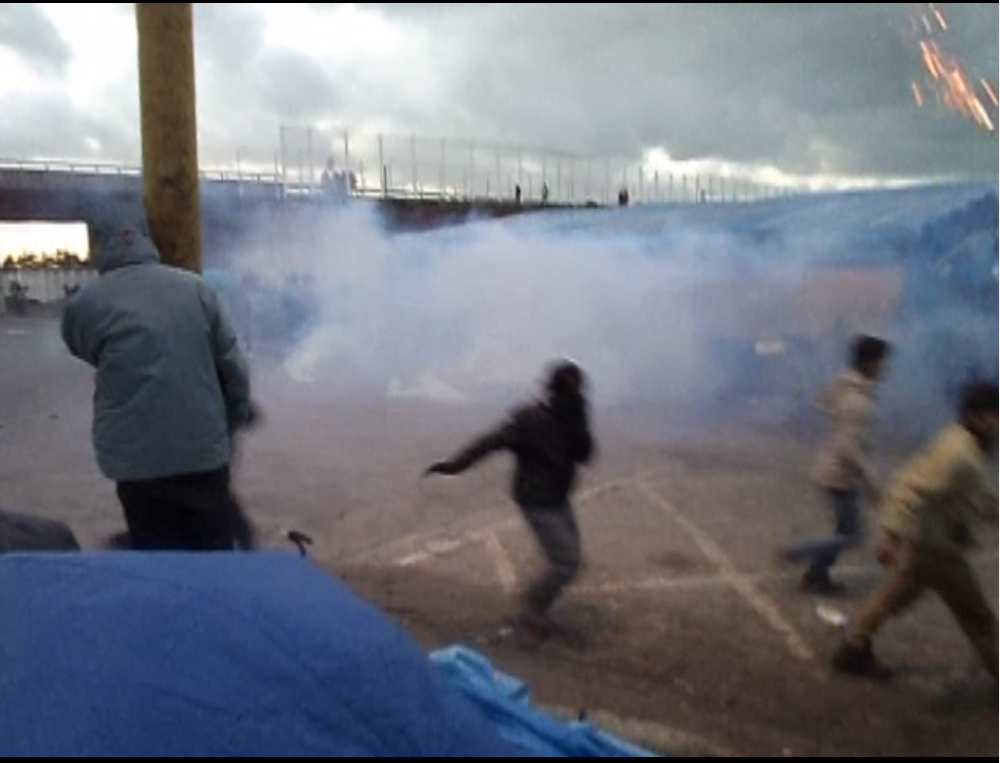
military reinforcements. Copious amounts of tear gas have been
deployed along with water cannon and warning shots with live
ammunition. Turkish officials have accused Greek forces of firing on
the crowds leading to deaths. Claims and counterclaims are part of
the propaganda battle and the Greek government has denied such
incidents though journalists continue to investigate.[1]
The latest reports
confirm that a Syrian man was shot and killed close to the Greek
border fence though currently few details are known.[2]
On March 2nd a child died at sea as people tried to cross
to the Aegean islands. Bad weather may be preventing more people from
crossing at the moment, but the Greek coast guard has been seen to be
taking its own measures by firing warning shots at packed boats. The
Greek government unilaterally suspended the right to asylum and is
now arresting anyone caught in its territory. New closed detention
centres are being prepared to house the arrested and already prison
sentences have been handed down.
Mitsotakis’ New Democracy party won election
last July in large part on a platform of restoring law and order.
This was principally a reaction to the image New Democracy crafted of
the supposedly lax and permissive left led administration of Syriza.
This was largely a figment of New Democracy’s imagination as Syriza
protected the EU’s borders and clamped down on internal protests
and social movements, but it was a line spread by the media and the
only way New Democracy could differentiate themselves from the left
since the outlines of policy in Greece are set by international
bodies.
Upon entering government
this led to a broad repressive programme and a series of blunders.
The anarchist and anti-authoritarian movement was attacked and some
of its squats and occupations evicted. Tensions have been mounting in
the Athens’ district of Exarcheia, which has been occupied by the
police in a bid to curtail the long-established anarchist and leftist
presence. The latest incident in this campaign saw an off-duty police
officer pull his gun on a crowd in a university.[3]
Especially short-sighted was the decision to evict the occupations of
the refugee solidarity movement which since 2015 had provided a
positive and effective alternative to the state’s overcrowded and
poorly maintained camps.
Mitsotakis’ government
was surprised when, despite having proclaimed a return to order, the
number of new arrivals on the Aegean islands increased over the
summer months. Since March 2016 tens of thousands of people have been
trapped on the Greek islands as the EU-Turkey deal limits the Greek
state’s ability to transfer people to the European mainland. A slow
asylum service and an EU resettlement programme that was never more
than a token effort created a situation where the island camps filled
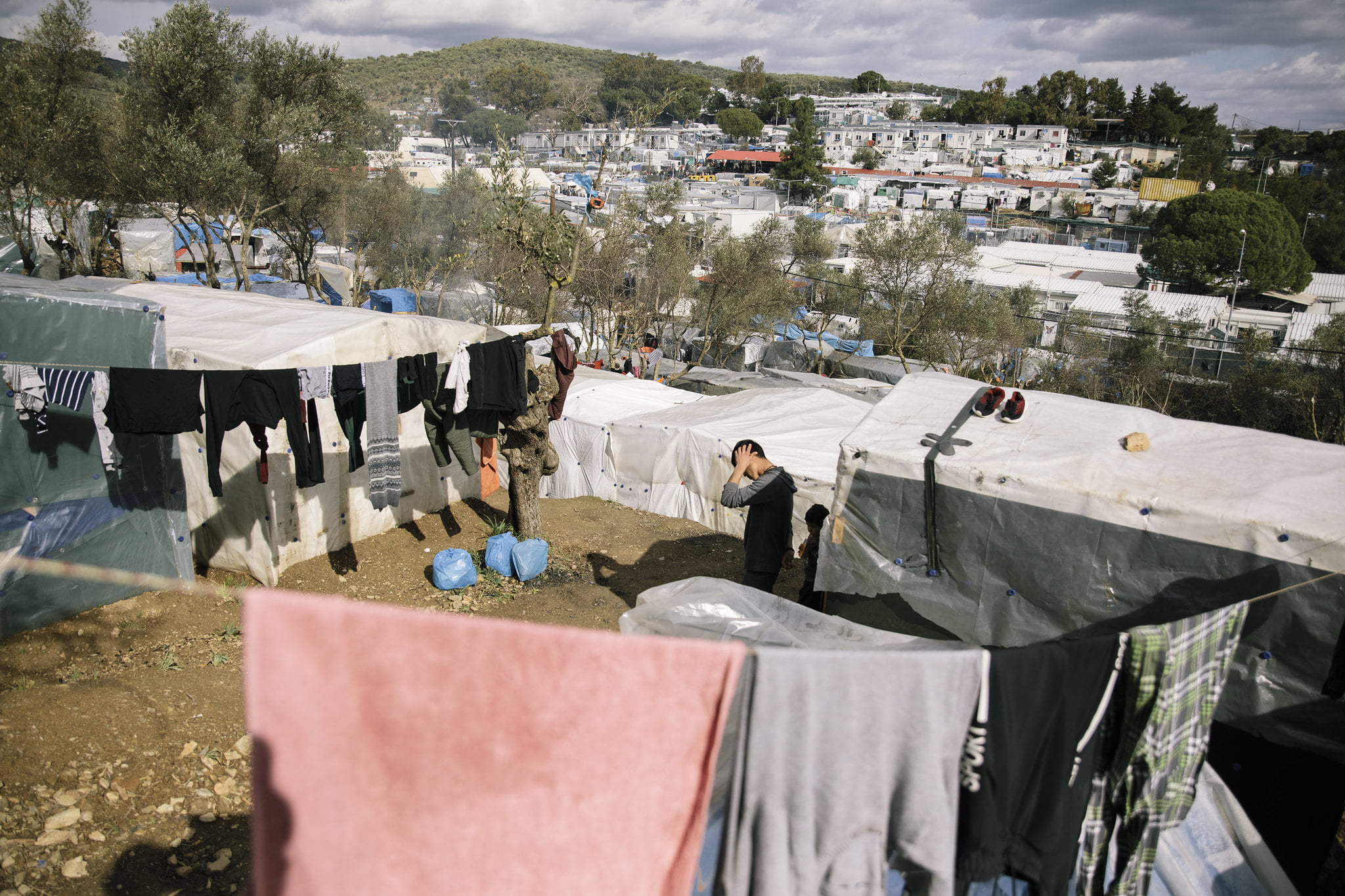
up faster than they could be emptied. Poorly-constructed and
maintained facilities for a few thousand instead ended up holding
tens of thousands creating a tragic situation. The most notorious
example is the Moria camp on Lesvos which by the end of last
September was reported to hold more than 12,000 people, 400%
overcapacity.[4]
Mitsotakis’ law and order agenda did nothing to
alleviate the situation on the islands, but his government doubled
down on the policy anyway. It proposed a series of new closed
detention camps and fast track deportations. The inhabitants of the
Aegean islands objected, so the government stated it would
requisition the land for the camps and awarded construction contracts
to a number of the country’s oligarch-owned construction companies.
When the islanders continued to object the riot police were sent in.
The last week of February saw dramatic scenes on the islands of
Lesvos and Chios as a general strike was called and a large cross
section of the population fought off the riot police. Roads were
blocked, an army barracks attacked and the hotel where police
officers stayed invaded and some officers beaten up in their beds.
Within two days some of the extra police units were pulled back.
At this point the government stood humiliated. Its law and order agenda had brought it to a dead-end as the only solution it had, the non-solution of building more camps, was blocked. This recent humiliation no doubt goes some way to explaining the government’s response to people turning up at its land border. By going hard on those on the Evros the government hopes to reassert its authority. Rather than seeking to calm tensions at the border they have instead upped the tension to pose as the strong and capable defender of the homeland. Government officials and supporters have been labelling the situation a “hybrid war” and “asymmetrical threat” launched by Turkey. Worse still, the arrival of people at the border has been called an invasion. The government has been whipping up a war atmosphere.
Succour to the far-right
This has stirred the imagination of the far-right.
For those who always claimed that migrants were “unarmed invaders”
(a line used by a previous New Democracy government as well) they now
see themselves vindicated as this is the government’s own framing.
Social media memes pose riot police officers as ancient Greek
warriors resisting ‘eastern barbarian hordes’ putting Greek
nationalism at the service of EU policy. The dehumanising rhetoric
has reached a new level as there is no longer the false debate over
who is a deserving refugee or an unwanted economic migrant, instead
the people at the border are not even people, they are merely weapons
in the hands of the ancestral enemy the Turks.
It is not clear whether
the government truly understands the forces it is potentially
unleashing with its rhetoric. Alongside the official mobilisation of
the state’s security services has been a mobilisation of the
far-right and citizens. Along the Evros border farmers have brought
tractors to help prevent crossings and citizens and businesses have
donated food to their ‘boys at the front’. More worrying are the
reports of civilians conducting armed patrols along the border and
organising anti-migrant “hunting” groups.[5]
On the islands the far-right groups who were also part of the
mobilisation against the riot police are blocking roads around the
refugee camps, preventing boats from landing and assaulting or
intimidating journalists, volunteers and NGO members. The targeting
of NGO’s fits in with the government’s messaging as both New
Democracy and SYRIZA tightened regulation of NGOs and volunteers or
portrayed them as involved in trafficking.[6]
With a complicit state and a fired up far-right base it is not
difficult to imagine the lengths some people might go to in order to
defeat this “invasion”. The irony of the situation is that an
administration hailed as the restoration of the liberal centre and
the return of law and order is contributing to a dangerous vigilante
atmosphere.
Current events must be
seen in terms of the mounting tension between the Greek and Turkish
states over the last two years but at its heart is the EU. This
situation has developed because of the EU’s attitude towards
refugees and migrants. If people seeking refuge or somewhere to live
were seen simply as that then the EU would not be vulnerable to
blackmail. If the Greek islands had not been used as open-air prison
camps for the last four years then the atmosphere of solidarity in
2015 and 2016 would not have become a breeding ground for the
far-right. The Greek state has its hands tied by the need to enforce
the terms of the EU-Turkey deal. It is the EU’s ‘shield’ as the
head of the European Commission put it in an unfortunate continuation
of warlike imagery.[7]
The use of Greece and other Mediterranean states
as a ‘warehouse of souls’ was neither a just nor sustainable
policy and it ultimately rested on keeping the unpredictable and
aggressive Erdogan happy. As was shown by the events on Lesvos and
Chios in February this policy had already reached its limits before
Erdogan’s intervention. The EU’s only solution to the situation
will be to hope that they can maintain their unsustainable policy a
little longer regardless of the cost to those on the border, in the
camps or those being deported to authoritarian regimes and warzones.
In this vein the German state has already offered a few million extra
to the Turkish coast guard.
The policies, ambitions and obsessions of the
Turkish and Greek states and the EU have created the current
situation. This potent mix of official incompetence,
short-sightedness and callousness has merged with the growing
far-right to create a toxic atmosphere which could yet spiral out of
control if things don’t de-escalate quickly. In these uncertain
times it is not clear what happens next, but we are already far down
a dark road.
~ Neil Middleton
References
[1]https://www.bbc.com/news/world-europe-51735715[2]https://vimeo.com/395567226[3]https://www.keeptalkinggreece.com/2020/02/24/policeman-off-duty-gun-students-university/[4]http://www.ekathimerini.com/244771/article/ekathimerini/news/greek-refugee-camp-unable-to-house-new-arrivals[5]https://www.keeptalkinggreece.com/2020/03/05/racist-group-hunters-illegal-migrants-volos/[6]https://www.dw.com/en/greece-ngos-accused-of-stoking-unrest-in-refugee-camp/a-52320720[7]https://www.theguardian.com/world/2020/mar/03/migration-eu-praises-greece-as-shield-after-turkey-opens-borderPic: The Moria camp on Lesvos, by Seebrucke
Subscribe to Freedom anarchist journal, sustain radical publishing and support independent media.
On the 15th of December, Alarm Phone received a call from 15 people stranded on Lipsi, a small island between Leros and Samos. They reported the situation to the Hellenic…