
|
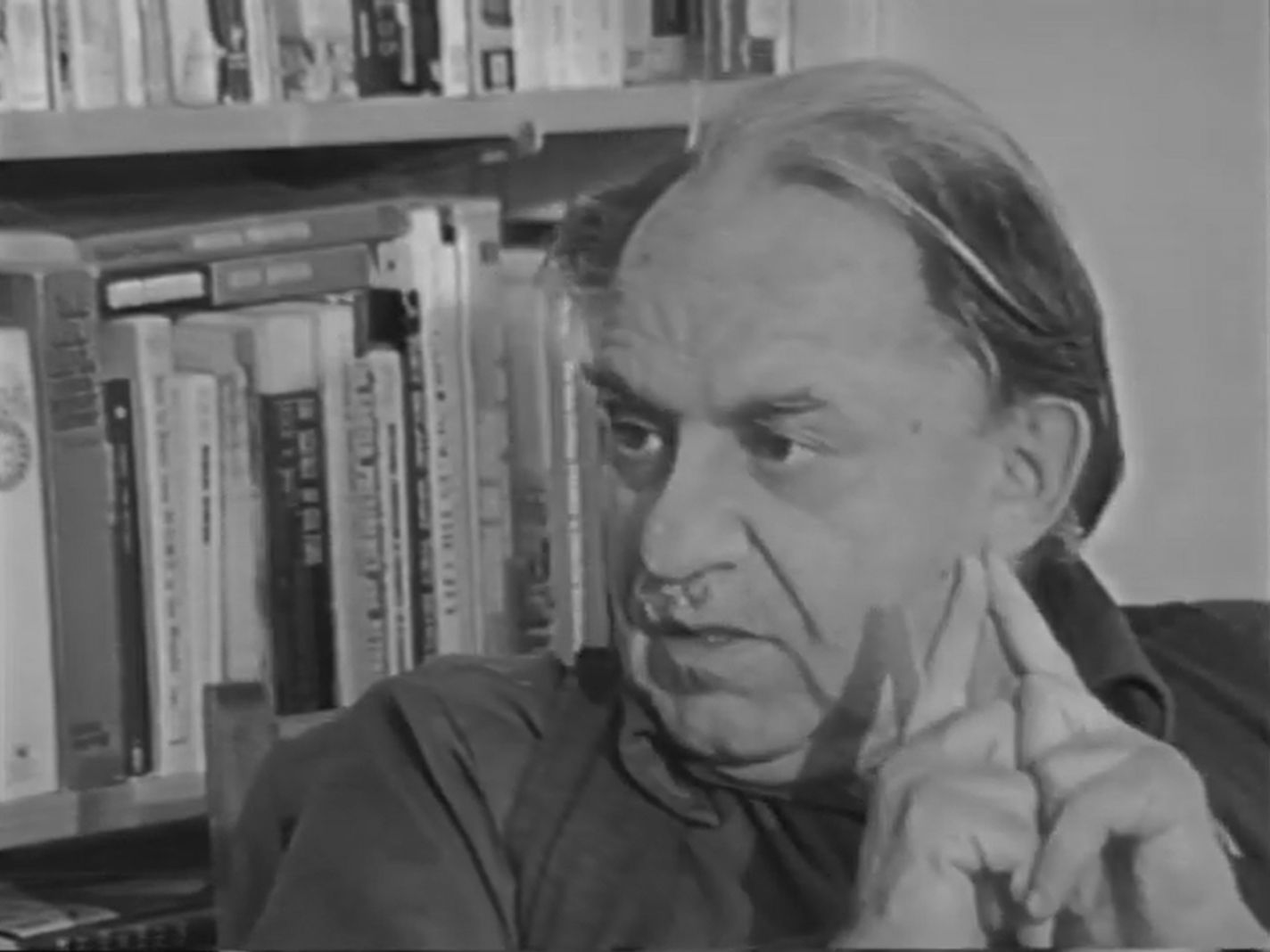
The bane of Murray Bookchin Thought
His critics accused him of veering away from the recognisable principles of anarchism
Jay Arachnid
30 July 2026
Murray Bookchin is rightly remembered for many things. He was a self-declared anarchist for a little more than three decades; according to the hagiography written by his long-term partner he became one in the late 1950s after moving away from the Stalinism of his youth, but he didn’t become known as one under his own name until the late 60s. Plenty of other anarchists found his analyses and positions to be lacking – he abandoned class struggle in the early 70s, tried to make common cause with the nascent right-wing “anarchists” of the Libertarian Party around the same time (even speaking at one of their conventions!), offered extremely uncritical support for the Sandinistas (because their red and black flag symbolised their adherence to anarcho-syndicalism – I’m not kidding), maintained a stubbornly inexplicable adherence to a Marxoid Hegelianism, and had a love-hate relationship with electoral politics by co-founding a local chapter of the Green Party.
By the mid-1980s, many of his critics had accused him of veering away from the recognisable principles of anarchism, an allegation he studiously ignored. His bitterness at being rejected as a leading figure of American – let alone international – anarchism, of an American Left Green caucus, or as anything more than a lecturer at a small private college where he directed the Institute for Social Ecology (ISE), led him eventually to slide into increasing irrelevance. He finally quit play acting, abandoning all pretence to being an anarchist – privately by 1995 and publicly in 1999.
Among his lingering legacies for anarchists are his ecological thought outlined in The Ecology of Freedom (1982), and his attacks on anarchists who didn’t toe his particular line. The former were long surpassed by works less enamoured with industrial technology, while the latter remained unsurpassed until the publication of the unintentionally hilarious Black Flame in 2009 (in which the authors outdid Bookchin, calling him out for even accepting that his targets were anarchists at all). According to his partner Janet Biehl, Bookchin told a few people that he was taking himself out of the club at the same time he wrote Social Anarchism or Lifestyle Anarchism: An Unbridgeable Chasm. This long essay is an incoherent screed, because there is no such thing as a “lifestyle anarchist”; in it, he denounced everyone he didn’t like who still wanted to be in the club, lumping their contradictory tendencies (neo-Situationists, hedonists, individualists, adventurists, postmodernists, apolitical anti-organisationalists, pluralists, Yuppies, and other avatars of “social reaction”) into a single scapegoat meant to explain the lack of popularity of some Official Anarchism.
And once he had sown more discord than any other single Anglophone anarchist, he walked away from the debate, leaving rancour and denunciation in his wake. In its stead, he created a vulgar Hegelian hybrid of allegedly vigorous Marxist analysis and weak left-wing social democratic practise, agrarianism and urbanism, bureaucratic centralisation and “libertarian municipalism” called communalism. This idiosyncratic invention, not anarchism, is what allegedly influenced the imprisoned Marxist Öcalan to push for an improved version of Kurdish nationalism, which, naturally enough, kept plenty of room for an official leadership and a historically hierarchical party structure. Apparently, every pro-PKK/YPG anarchist missed that memo.
There has never been a shortage of anarchists who get annoyed at other anarchists for ruining their club, but Bookchin’s caricature, the “lifestyle anarchist,” has bizarrely maintained a certain cachet among sectarians. This, despite the mismatched jumble of characteristics he cobbled together, and the documented revelation of his simultaneous rejection of anarchism – not just the “lifestyle” heresy. That he turned away from anarchism at the same time he slammed the tendencies that he found annoying should make even the most sectarian among us pause to consider the taint of Bookchin not actually wanting to “save” anarchism when his screed was published. Critical responses to SALA as well as other aspects of Murray Bookchin Thought include works by Bob Black, David Watson, Jason McQuinn, and others.
Meanwhile, two of the brightest stars in the ISE constellation, John Clark and Chuck Morse, came out of these destructive discussions with their eyes opened to much of what was wrong in Murray Bookchin Thought. Their post-mortems are well worth reading for anyone who might still believe that Bookchin was anything other than a bane on late-20th century and early 21st century anarchism.
Read Yavor Tarinski’s opposing perspective
Subscribe to Freedom anarchist journal, sustain radical publishing and support independent media.
Share
Abolition









Subscribe to Freedom anarchist journal, sustain radical publishing and support independent media.
SUBSCRIBE
AND DONATE
Latest
The legacy of Mikhail Bakunin
His social conflict analysis, naturalist materialism, and organisational dualism continue to inspire
Felipe Corrêa
|
28 July 2026

The Case of the Spinning Judge
Imagine what it feels like to sentence war resisters as terrorists
Tabitha Troughton
New In




Freedom
Bookshop
1968
Freedom Press

Browse over a century of anarchist commentary and reporting from the Freedom digital archive
EXPLORE THE
Archives