Despite well-documented evidence of its origin, numerous fanciful speculations persis
Tomás Ibáñez
|
26 August 2024
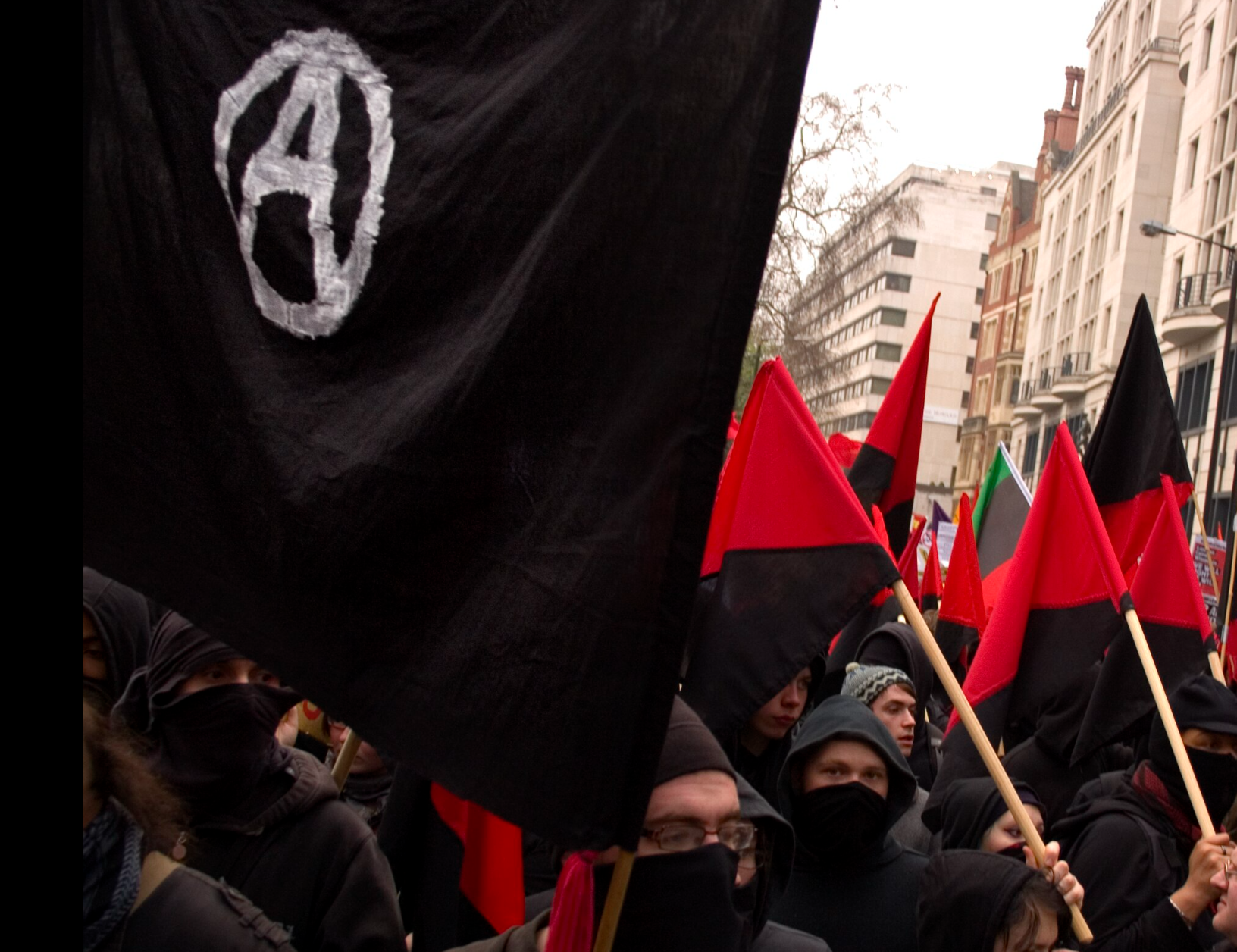
Despite well-documented evidence of its origin, numerous fanciful speculations persist, including within anarchist circles and many libertarian historiographies that explore the symbol’s origin. It’s essential to clarify that we are concerned with the history of an anarchist symbol rather than a specific design. While representations of the letter A enclosed within a circle have certainly existed for centuries, they held no connection to anarchism.
Read part one here.
Here are a few true and false statements about the circled A.
→ The circled A has always part of anarchism: False
The connection between the circled A symbol and anarchism is so deeply ingrained that for a significant period, it was believed they were inherently linked and had ancient origins. The lack of information surrounding its inception fostered a sense of mystery, perpetuating this misconception.
→ The circled A did not appear until April 1964: True
It developed gradually as a symbol of anarchism, becoming widespread only from the 1970s onwards, starting in Italy.
→ The circled A was intended to evoke “order without power”, following Proudhon’s well known sentence: False
This assertion suggests that the “A” of anarchy, symbolizing the absence of power, is enclosed within the “O” of order. However, this interpretation was never conceived by the young libertarians who sought to establish a symbol for anarchy. There is no connection between the circled A and Proudhon’s concept, nor with the notion of order, as evidenced by the diverse evolution of the circled A, particularly when it was revitalized by the punk movement, transcending the confines of a closed circle.
→ The seal of the Federal Council of the International Workers Association of Spain depicted a circle A from 1870 onwards: False
This seal, featuring a combination of a square and a plumb line, bears a closer resemblance to freemasonry than anarchism. At the time, the Spanish section of the IWA, despite being heavily influenced by Bakunin, did not explicitly identify as anarchist. Therefore, the seal did not intend to symbolize anarchism.
→ The circled A already appeared on the helmet of a militiaman during the Spanish Revolution: False
Despite efforts to discern a circled A on the helmet, it’s challenging to interpret the depicted lines as forming the symbol. Even if a militiaman had indeed drawn a circled A on his helmet, it wouldn’t represent a symbol of anarchism, as the circled A was entirely absent from the Spanish Revolution.
→ The circled A appeared in the Bulletin of the Alliance Ouvrière Anarchiste (Anarchist Workers Alliance) as early as 1957: False
What was featured in the bulletin of this small French-speaking anarchist organization was the acronym of AOA, with the letter “O” (for Ouvrière) enclosed within the letter “A” (for Alliance) and a second letter “A” (for Anarchist) inserted within the letter “O.” This contrasts sharply with the circled A which could only symbolize anarchy when detached from any specific organization. It wasn’t until June 1968, four years after its inception, that the circled A was utilized in the AOA bulletin.
~ Tomás Ibáñez
Subscribe to Freedom anarchist journal, sustain radical publishing and support independent media.