
|
Britannia chained: The assault on our rights has begun
Carl Spender
6 February 2020
This week has seen a raft of draconian law & order policies floated by the government and police representatives. Carl Spender examines these grim omens of the future.
And so it begins: returned to government with a thumping majority, Johnson’s Tories have begun a crackdown on those pesky legal rights that risk getting in the way of their plans to transform the UK into “Singapore-on-Thames”. A preview of coming attractions was already offered to us last year, in the form of the government consultation on new laws to target GRT communities. But, in a series of speeches and anouncements this week, government ministers – and the police – laid out a much more comprehensive vision of the law-and-order society they want to create.
Sentencing
“Toughen up sentences” has been Tory policy more or less since the party was founded in 1834, but in the wake of the recent knife attacks in Streatham and London Bridge, there has been a renewed drive for the state to lock up more people for longer. On Monday, the Lord Chancellor and Secretary of State for Justice, Robert Buckland, told the House of Commons that the government would seek to pass emergency legislation that will ensure those convicted of ‘serious terrorist offences’ serve two-thirds of their sentence rather than half, and only be eligible for release then if the Parole Board deems them safe. Such a move would potentially bring the UK into conflict with Article 7 of the European Convention on Human Rights (ECHR) but legal experts are far from unified in this view. The ECHR – which is entirely separate from the EU – has long been a target of Tory ire, with the party’s 2019 manifesto promising an ‘update’ of the Human Rights Act, which enshrines the provisions of the ECHR in domestic law. On Tuesday, a government spokesman did not rule out a temporary derogation from the convention in order to put the new laws in place and said the legislation could be introduced in the next few days. Whether it will affect only those convicted of terrorism offences or, in line with Johnson’s election pledge, a wide range of serious criminal acts remains to be seen. Irrespective, Buckland’s speech to the House undoubtedly heralds the beginning of the long-brewing Tory war on civil rights. Police bail
It’s not only those convicted of crimes that will be facing a tougher regime of regulation. Yesterday, Britain’s poundshop Duterte, Priti Patel, announced that the Home Office was consulting on a set of proposals to strengthen pre-charge or police bail, which allows the cops to impose conditions on individuals who are being investigated – but have not yet been charged – with an offence. Patel’s proposals include:
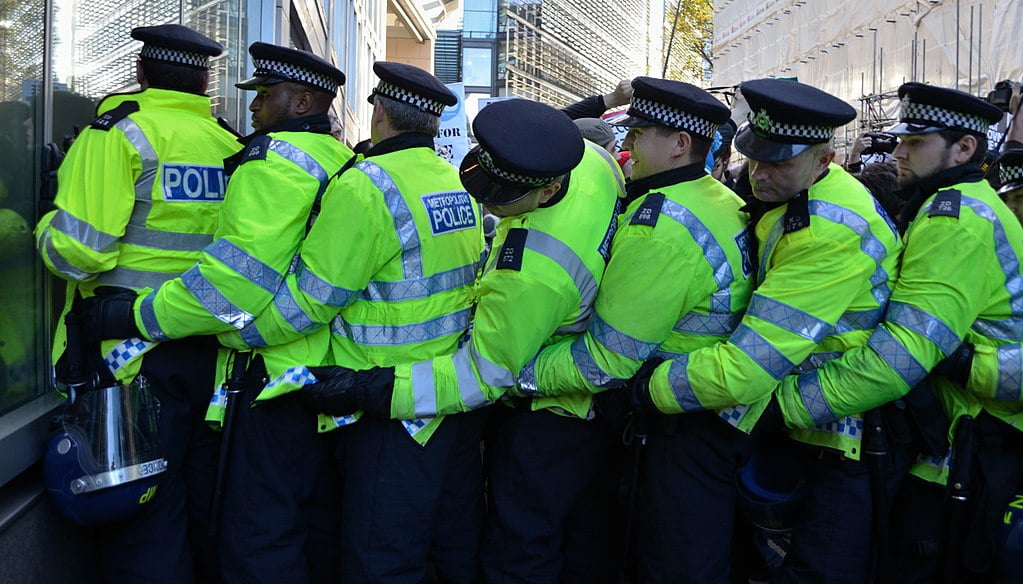
Apter isn’t the only ‘wise old copper’ who has sensed an opportunity this week. Metropolitan Police Commissioner Cressida Dick (aka “Hollow Point”) has also redoubled her calls for greater legal powers to deal with protest groups like Extinction Rebellion. Speaking to the London Assembley yesterday, Dick called for a range of changes to public order policing powers, specifically:
Picture Credit: DulcieLee on Flickr used under CC BY 2.0
“Toughen up sentences” has been Tory policy more or less since the party was founded in 1834, but in the wake of the recent knife attacks in Streatham and London Bridge, there has been a renewed drive for the state to lock up more people for longer. On Monday, the Lord Chancellor and Secretary of State for Justice, Robert Buckland, told the House of Commons that the government would seek to pass emergency legislation that will ensure those convicted of ‘serious terrorist offences’ serve two-thirds of their sentence rather than half, and only be eligible for release then if the Parole Board deems them safe. Such a move would potentially bring the UK into conflict with Article 7 of the European Convention on Human Rights (ECHR) but legal experts are far from unified in this view. The ECHR – which is entirely separate from the EU – has long been a target of Tory ire, with the party’s 2019 manifesto promising an ‘update’ of the Human Rights Act, which enshrines the provisions of the ECHR in domestic law. On Tuesday, a government spokesman did not rule out a temporary derogation from the convention in order to put the new laws in place and said the legislation could be introduced in the next few days. Whether it will affect only those convicted of terrorism offences or, in line with Johnson’s election pledge, a wide range of serious criminal acts remains to be seen. Irrespective, Buckland’s speech to the House undoubtedly heralds the beginning of the long-brewing Tory war on civil rights. Police bail
It’s not only those convicted of crimes that will be facing a tougher regime of regulation. Yesterday, Britain’s poundshop Duterte, Priti Patel, announced that the Home Office was consulting on a set of proposals to strengthen pre-charge or police bail, which allows the cops to impose conditions on individuals who are being investigated – but have not yet been charged – with an offence. Patel’s proposals include:
- Removing the presumption against pre-charge bail;
- Placing a duty on officers to use pre-charge bail in cases where it is necessary and proportionate, including for cases where there are risks to victims, witnesses and the public; where it could prevent reoffending and where the offence in question has significant real or intended impacts;
- Allowing officers of a lower rank to authorise and extend pre-charge bail;
- Extending the initial period where pre-charge bail can be applied from 28 to either 60 or 90 days, as well as delaying the point at which magistrates’ approval for the extension of bail is required from 3 months to 6, 9 or 12 months; and
- Introducing ‘review points’ in codes of practice for investigations where pre-charge bail is not used, including where individuals are interviewed voluntarily or released under investigation.
Apter isn’t the only ‘wise old copper’ who has sensed an opportunity this week. Metropolitan Police Commissioner Cressida Dick (aka “Hollow Point”) has also redoubled her calls for greater legal powers to deal with protest groups like Extinction Rebellion. Speaking to the London Assembley yesterday, Dick called for a range of changes to public order policing powers, specifically:
- Public nuisance to be made a statutory – rather than a common law – offence. (1)
- A lowering of the threshold before which conditions can be imposed on protests or assemblies under s12 and 14 of the Public Order Act 1986. (2)
(1) Public nuisance will be the subject of a forthcoming article, in which I’ll examine the reasons why the cops would like PN to become a statutory offence.
(2) s12 and 14 of the Public Order Act currently say that conditions can be imposed on a public assembly or procession if and only if “it may result in serious public disorder, serious damage to property or serious disruption to the life of the community”. The cops want the requirement that the disorder, damage or disruption be ‘serious’ to be removed or downgraded.
Picture Credit: DulcieLee on Flickr used under CC BY 2.0
Activism and law








Freedom
Bookshop
Activism and law

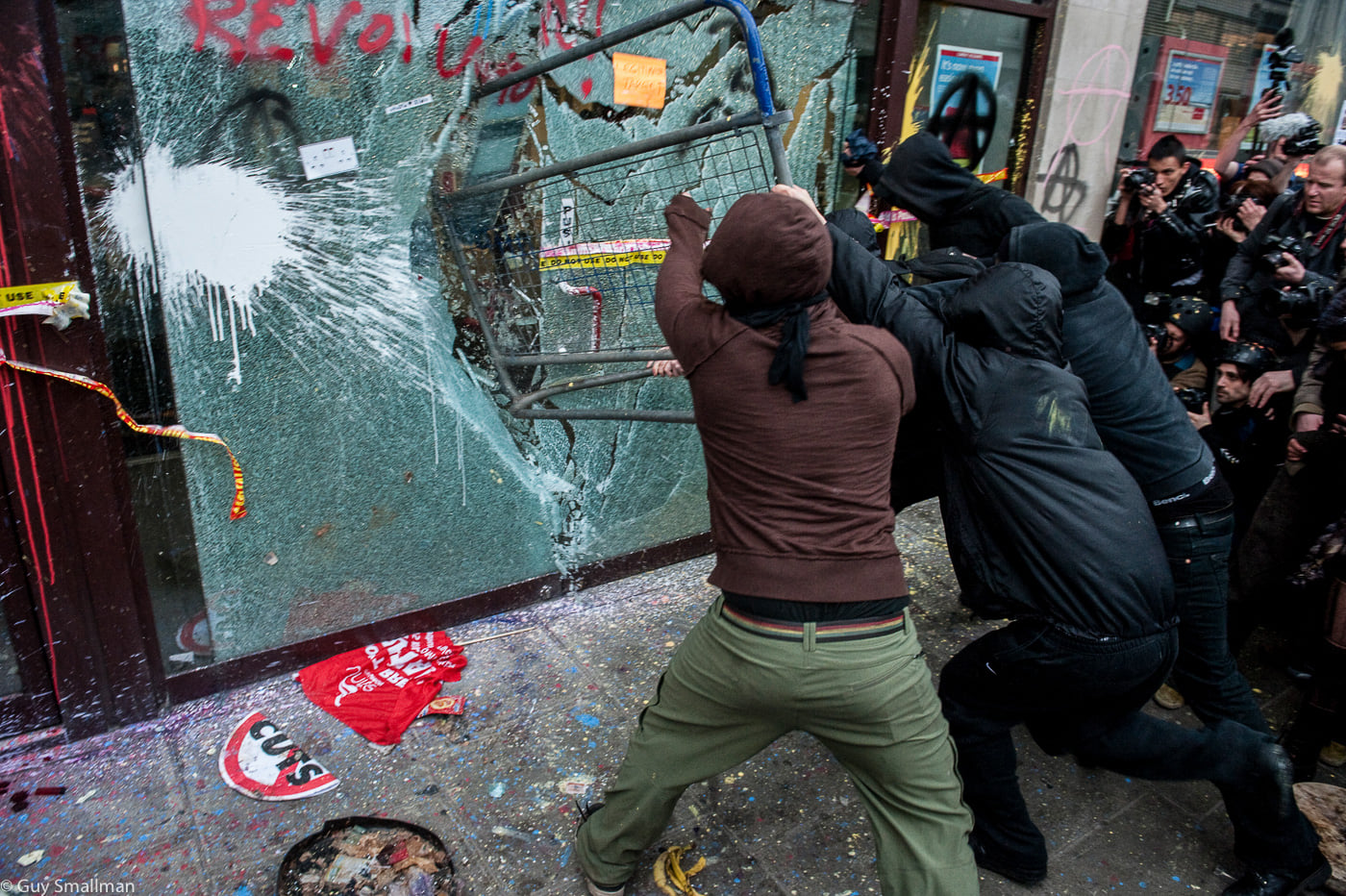
Rioting and Violent Disordering
Triple helpings of jail all-around planned for Bristol protestors. On Thursday 13th of May, eight people were charged with rioting…
Andy Meinke
New In












Freedom Press



Subscribe to Freedom anarchist journal, sustain radical publishing and support independent media.
SUBSCRIBE
AND DONATE
Latest
Churchill vandalism case win, and thoughts on masked fash
Anarchist News Review: Andy, Tab and Simon hail some good news for pigeons as a jury throws out the infamous Churchill statue vandalism case.
Freedom News
|
18 September 2026

Autistici/Inventati: “We need 1,000 more infrastructures of dissent to be born”
Interview with the Italian digital collective, de-banked and shut down after US “terrorist” designation
Gabriel Fonten
Browse over a century of anarchist commentary and reporting from the Freedom digital archive
EXPLORE THE
Archives