
|
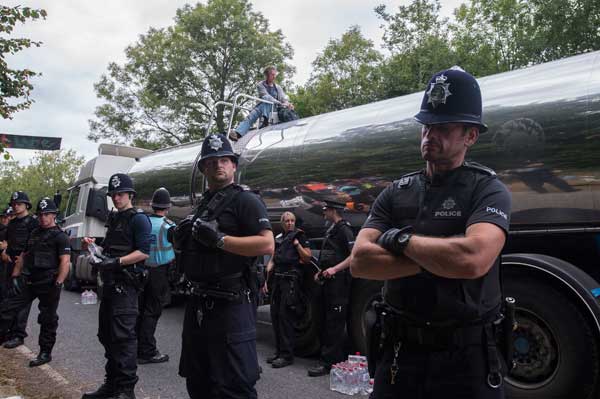
Fracking Moratorium or Electioneering? December 12th and Brexit May Hold The Key
Al Williams
10 December 2019
Fracking Moratorium or Electioneering?
December 12th and Brexit May Hold The Key
A month ago, shortly after calling a
General Election, the Conservative Government abruptly decided to pass a
moratorium on fracking, citing concerns about seismicity. To
many, the decision looks like electioneering; a pledge to put fracking on
pause while marginal seats in threatened areas can be won.
However, some
frontline campaigners have not been fooled by the political chicanery.
The government did not state how the
moratorium will be applied, but it seems that only fracking is on pause,
meaning that drilling and testing operations aren’t included. The official
definition of fracking, as stated in the Infrastructure Act of 2015, is based
on the volume of water used per frack, which means that a number of ongoing
operations to prospect for hydrocarbons in shallower geology, which use less
water are exempt. This together with the political uncertainty means the battle
against unconventional oil and gas is not yet won.
Within days of the moratorium, the
government appeared to do an about face, with Andrea Leadsom declaring
that shale gas was “a great opportunity for the UK” and something that “the UK
will need for the next several decades”.
The Ministry of Housing, Communities
and Local Government then published the results of their consultation on
whether fracking sites should be made Nationally Significant Infrastructure
Projects. This appeared to cloud the issue, stating
that although it had “taken a presumption against issuing any further
Hydraulic Fracturing Consents”, it considered the possibility that “future
applications will be considered on their own merits” and that “there could be
considerable merit in taking forward these proposals in the future.”
The unpopular technology has met with
strong community resistance wherever it’s been proposed. This week, the
long-awaited release of a government report, revealed that “low public
acceptance of shale” was the principal obstacle to the industry’s ability to
develop shale reserves. After a 22 month Freedom of Information request by
Greenpeace’s Unearthed, the report remains heavily redacted due to concerns it
could question the industry’s viability.
There are concerns that a win for the
Tories in this week’s election would enable Boris Johnson to deliver his Brexit
deal and enable legislative changes to pave the way for a revival of the
industry’s fortunes.
Research by Paul Mobbs
suggests that investments in fracking and Brexit are linked, suggesting that
Brexit will mean a new push to frack. The infamous Tufton Street acts as a
nexus for key lobbyists linked to ‘dark money’ flows originating from the USA.
A series of fracking-induced
earthquakes at Preston New Road in Lancashire, peaked with a 2.9 magnitude
seismic event in August, which caused structural damage to local properties
forcing the Oil and Gas Authority to halt fracking until more evidence could be
collated. Even local Conservative MP, Mark Menzies, has now come out against
it, suggesting the technology is now unviable on the Fylde. Cuadrilla have been
unable to produce viable commercial quantities of gas which has dealt a reality
check to investors. In 3 years they’ve only been able to drill one
vertical well with two horizontal sidetracks, both of which were only partially
hydraulically fractured. Although the company claim to have produced 1.3
million cubic feet of gas, any gas produced was flared, with no proof
that any significant volumes have actually been recovered. Equipment has
continued to leave the site in recent weeks. Flow testing of the fracked
wells has concluded and a minimal operation remains in place.
At the end of November Cuadrilla’s
permission to drill and frack at Preston New Road expired. Campaigners
responded by taking down their gate camp monitoring post opposite the site.
It has since been revealed
that at least 10 of the companies 26 employees have left the company in recent
months.
With the potential sale of Cuadrilla
mooted, and permission for the nearby Roseacre site denied, this could be the
end of attempts to exploit shale gas on the Fylde.
Whilst much attention has focused on
Preston New Road, a number of operators continue to attempt to exploit oil
reserves in Surrey and Sussex. A cluster of earthquakes, measuring up 3.1
magnitude have been registered in the vicinity of the Horse Hill and Brockham
sites. Campaigners
have demanded that government extend the moratorium to include the use of
acid stimulation.
Acid has been used at various sites across
Southern England and is also proposed at West Newton in East Yorkshire and
Wressle in Lincolnshire. Egdon’s application in this latter case is unique as
it’s proposing to use hydrofluoric acid to stimulate the well. Having already
refused the proposal three times, the scheme was subject to a second public
inquiry that went ahead despite the moratorium. The decision has now been
deferred, suggesting it’s too politically sensitive to announce before the
election.
Meanwhile INEOS and Aurora Resources
are proceeding with applications in South
Yorkshire and Lancashire,
suggesting they believe the moratorium to be no barrier to their aspirations.
Ultimately, it will be either
economics or legislative bans that end the industry’s hopes. Exploitation of
shale hydrocarbons is a classical Ponzi scheme which has seen net losses in the
USA running to hundred of billions of dollars. The country’s second largest
fracking company, Chesapeake Energy, now
appears close to bankruptcy following a share price crash, amid reports
it’s drowning in over $10 billion of debt.
With even The
Financial Timesdeclaring that fracking was a poor investment some
12 months ago, the writing has looked on the wall and share prices in companies
such as AJ Lucas (Cuadrilla’s Australian parent company), IGas and Angus Energy
have undergone heavy losses over the past 12 months.
Labour have stated they will ban the technology. If they win the election, this ban must be extended to include other unconventional techniques such as acid stimulation and coal bed methane. However, the party currently in power appear to still be enabling it through the backdoor in the run up to December 12th. Huge amounts of money have been invested in Brexit and American investors have been sizing up the UK’s shale reserves, hopeful that sweeping political changes will enable new outcomes. As such, the election result and the resolution of Brexit appear to be key to determining if the decade long fight against fracking can be won.
Al Williams
Photo credit: Guy Smallman
Anti-fracking
















Freedom
Bookshop
Anti-fracking


Not Guilty: Reflections from Pont Valley Trial
Last week, 6 defendants from the Campaign to Protect Pont Valley were acquitted at Teeside Magistrates Court for direct action…
Campaign to Protect Pont Valley
New In



















Freedom Press




















Subscribe to Freedom anarchist journal, sustain radical publishing and support independent media.
SUBSCRIBE
AND DONATE
Latest
Churchill vandalism case win, and thoughts on masked fash
Anarchist News Review: Andy, Tab and Simon hail some good news for pigeons as a jury throws out the infamous Churchill statue vandalism case.
Freedom News
|
18 September 2026

Autistici/Inventati: “We need 1,000 more infrastructures of dissent to be born”
Interview with the Italian digital collective, de-banked and shut down after US “terrorist” designation
Gabriel Fonten
Browse over a century of anarchist commentary and reporting from the Freedom digital archive
EXPLORE THE
Archives