
|
Portugal: The dockers’ struggle
A deep dive into the background of dockworker strikes in Portugal, which kicked off spectacularly in November with casualised workers taking action in Setúba and overtime bans linked to proposed pay cuts holding across most of the country’s major ports
Pedro Friere
2 January 2019
In Portugal, this past year has been a year of intermittent dockworker strikes, a situation that has been passing by the majority of the population.
The general consensus amongst the public about this strike, is that the worst that could happen would be some stocking issues with medicine. Essentially, that it’ll all be fine.
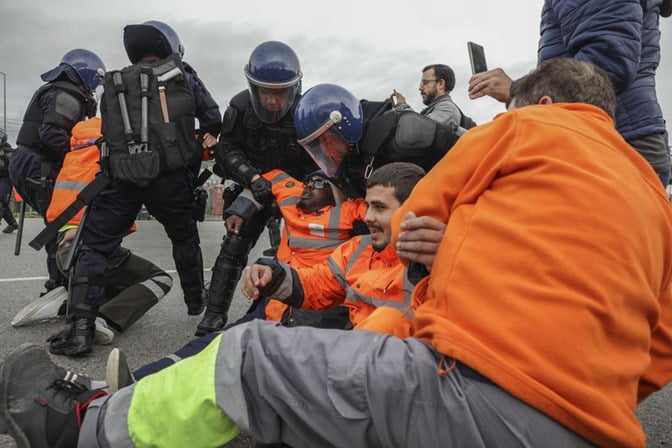
On November 5th however the dockers of the port of Setúbal (port city south of Lisbon) carried out a total strike (not partial as usual) and protested at the port entrance, letting nothing and nobody pass through.
Given the circumstances this strike attracted a great deal of attention due to its proximity to the Volkswagen AutoEurope factory. This facility is very dependent on Setúbal port to export its production. Pressure from Volkswagen Portugal, which has already threatened to shut the factory because it has nowhere to store its finished cars, pushed the government to act.

The Seas Minister responded to media interest by sending an open letter to the administration of the port of Setúbal, supporting the dockers, saying on the letter that is already about time for finishing the daily contracts, yes daily, although they work every day without fail, always the same people and still receive day by day.
The administration of the port of Setúbal stated categorically that there are no precarious working conditions. But if this is not precarious work, then what is it?
To please its HQ in Germany, VW AutoEurope has been aggressively seeking alternatives such the port of Leixões (north of Porto) or even Spanish ports.
On the day following this announcement by Volkswagen Portugal, police were assigned to dismantle the dockworkers’ pickets at the entrance of the port of Setúbal to let through buses containing scab workers.
After all, the Portuguese government is on whose side? It seems to me that they’re more interested in pleasing the interests of Volkswagen, instead of the workers and people.
The strikers have been asking for something as simple as a collective labour contract (a special commercial agreement, usually negotiated “collectively” between company management and trade unions on behalf of the employees. The collective agreement regulates the terms and conditions of employees, their duties and those of the employer. It is usually the result of collective bargaining between bosses and unions).
If they had known to organise themselves for an “occupation strike”, in which they took the port itself, it would have been easier to stop the use of scabs in addition to being out of the reach of police forces.
These comrades were not instructed as they should have been however, because the system will never give us the education we need to oust it from power.
I strongly recommend the reading of Tom Brown’s Syndicalism, where in addition to explaining how to organize a revolution and keep it standing, Brown explains A + B how the economy would work in a syndicalist system as well as going into detail on strike tactics.

They are the only dangerous minority, we are the majority, we control production, we have the powers we need, to use them in our favor, we need education for that and for that, we can only count on ourselves.
The working classes need organization now more than ever. Not only due to the rise of right-wing populism, but also for the sake of the planet. We control the production and we need mass strikes to fight climate change and injustice. Whether the establishment like it or not, the wind of change belongs to the working classes.
Pedro Friere
Edited by Thomas Brace
A tentative agreement was struck just before Christmas at Setúbal in which 56 temporary dock workers were to be integrated with the full-time workforce. The overtime ban, which covers the ports of Lisbon, Setúbal, Sines, Figueira da Foz, Leixões, Caniçal (Madeira), Ponta Delgada and Praia da Vitória (Azores), is set to continue to the end of this month.
Pedro Friere is an anarcho-syndicalist based in Lisbon. Alongside working with FAI and AFed to revitalise the Portugese Anarchist Union, he also joined UDLA in April 2018 and is a member of the Subvert Collective.
Casualisation















Freedom
Bookshop
Casualisation

New In







Freedom Press











Subscribe to Freedom anarchist journal, sustain radical publishing and support independent media.
SUBSCRIBE
AND DONATE
Latest
Churchill vandalism case win, and thoughts on masked fash
Anarchist News Review: Andy, Tab and Simon hail some good news for pigeons as a jury throws out the infamous Churchill statue vandalism case.
Freedom News
|
18 September 2026

Autistici/Inventati: “We need 1,000 more infrastructures of dissent to be born”
Interview with the Italian digital collective, de-banked and shut down after US “terrorist” designation
Gabriel Fonten
Browse over a century of anarchist commentary and reporting from the Freedom digital archive
EXPLORE THE
Archives